Macro Calculator for Body recomp: How to Set Calories, Protein, Carbs, and Fats
Body recomposition is a popular approach for people who want to lose body fat while building or maintaining muscle. Unlike a traditional diet that focuses mainly on reducing scale weight, recomp aims to improve body composition over time. The challenge is finding the right balance of calories and macronutrients without creating an overly aggressive calorie deficit.
A macro calculator for body recomp can make this process easier by helping you estimate how much protein, carbohydrates, and dietary fat you should consume based on your calorie target and goal. However, a calculator is only a starting point. Your training, recovery, activity level, and progress over several weeks also matter.
This guide explains how body recomposition works, how macros are calculated, and how to use your results effectively.
What Is Body Recomposition?
Body recomposition, often shortened to “recomp,” means attempting to improve your ratio of muscle to body fat at the same time.
In practical terms, the goal is to:
- Reduce stored body fat
- Build or preserve lean muscle
- Maintain a relatively stable body weight or experience gradual weight loss
- Improve strength and physical appearance
Traditional dieting usually puts the emphasis on losing weight, while a muscle-building phase generally involves eating enough calories to support growth. Recomposition sits somewhere between these approaches.
Research and practical examples suggest that gaining muscle while losing fat is possible, particularly in people who are newer to resistance training, returning after a break, or have sufficient body-fat reserves to support the process. The supplied research material also notes that body recomposition can occur outside complete beginners, although results vary considerably between individuals.
The process is not normally fast. Because muscle gain and fat loss can happen relatively slowly, the number on the scale may not change dramatically even when body composition is improving.
How a Macro Calculator for Body Recomp Works
A macro calculator takes several pieces of information and uses them to estimate your nutritional targets.
Common inputs include:
- Age
- Sex
- Height
- Body weight
- Activity level
- Training frequency
- Estimated calorie needs
- Primary goal
The calculator then converts the calorie target into three major macronutrients:
Protein: supports muscle repair and growth.
Carbohydrates: provide energy for training and daily activity.
Fat: supplies energy and helps provide essential fatty acids.
The exact ratio does not have to be identical for everyone. Two people with the same body weight can have different calorie requirements because their activity levels, training routines, body composition, and lifestyles may differ.
That is why simply copying another person’s macros is usually less useful than calculating a starting point based on your own circumstances.
Step 1: Determine Your Calorie Target
Before dividing calories between protein, carbohydrates, and fat, you need a reasonable estimate of your daily energy requirements.
Your maintenance calories represent approximately how much energy you need to maintain your current body weight under your usual activity conditions.
A TDEE calculator can be useful for estimating this starting point because total daily energy expenditure accounts for more than your resting metabolism. It also considers activity and other components of daily energy expenditure.
Once you have an estimated maintenance level, you can decide whether your recomp strategy should involve a small deficit, maintenance intake, or another calorie target.
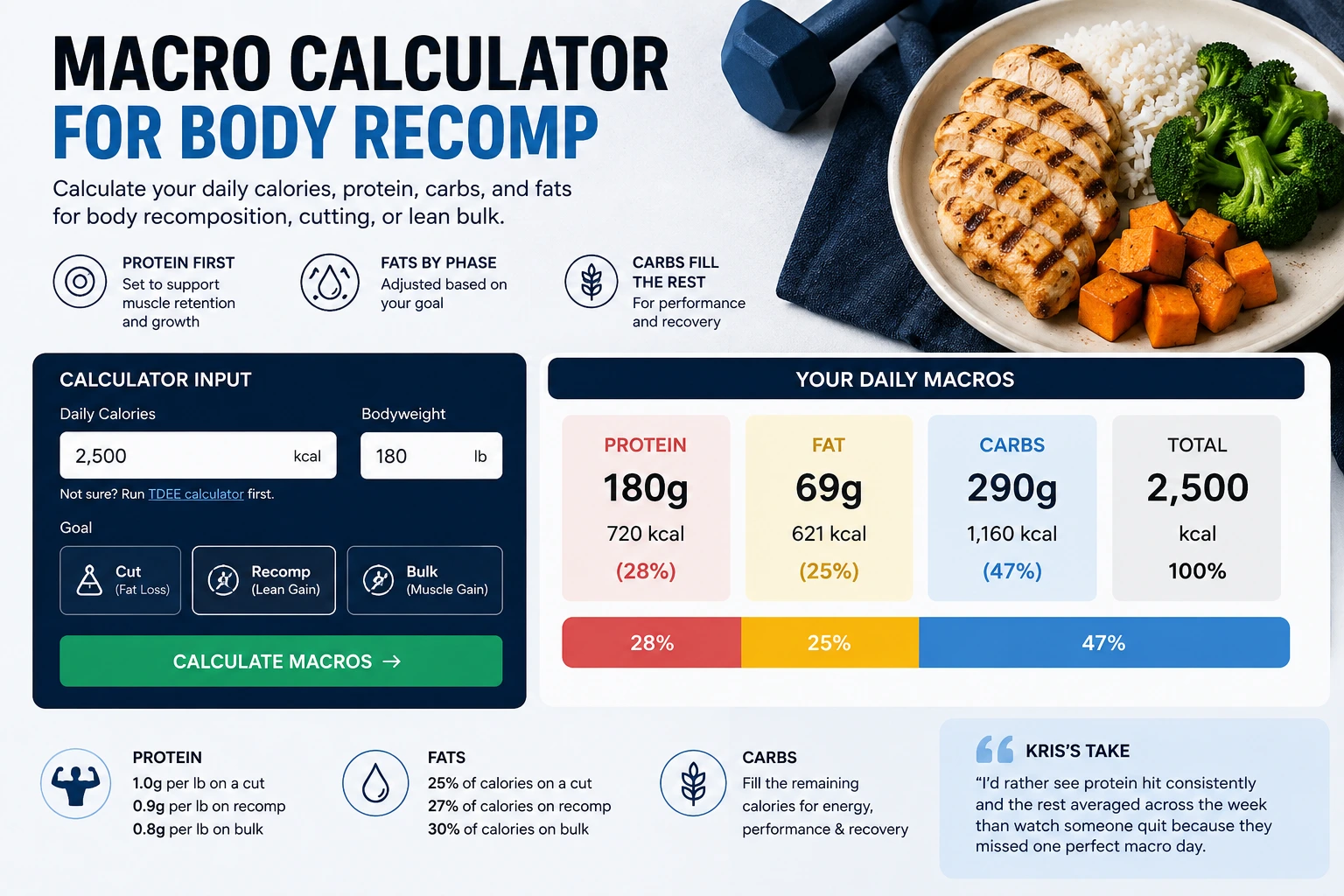
For example, suppose someone’s estimated maintenance intake is 2,500 calories per day. Rather than immediately creating a very large deficit, a recomp approach may use a modest reduction depending on the person’s goals and circumstances.
The supplied research material highlights that a smaller deficit may be more suitable for preserving the possibility of muscle growth, while larger deficits can make muscle gain increasingly difficult.
The important point is that body recomposition should not automatically mean eating as little as possible.
Step 2: Prioritize Protein
Protein is arguably the most important macronutrient when you’re trying to improve body composition.
During resistance training, muscle tissue is exposed to a stimulus that requires adequate protein and recovery to support repair and adaptation. When calories are restricted, getting enough protein becomes even more important because the body has fewer overall energy resources available.
The supplied research review discusses studies in which people consuming higher protein intakes during calorie deficits achieved better muscle-related outcomes while also losing fat. It suggests that approximately 0.8 grams of protein per pound of body weight can be a practical target, with around 1 gram per pound being an option for people who want to be more conservative about protein intake during a deficit.
Another way to express protein intake is in grams per kilogram of body weight.
For example, a person weighing 70 kg could start with a protein target somewhere around 110–140 grams per day, depending on their overall calorie intake, training status, and individual needs.
A calculator can make this calculation much easier, but the number should still be viewed as a practical target rather than an unchangeable rule.
Step 3: Set Your Dietary Fat Intake
After establishing calories and protein, dietary fat can be allocated according to personal preference and nutritional needs.
Fat is calorie-dense, providing approximately 9 calories per gram. Protein and carbohydrates provide approximately 4 calories per gram.
Good sources of dietary fat can include:
- Nuts and seeds
- Olive oil
- Avocado
- Eggs
- Fatty fish
- Nut butters
- Dairy products, depending on individual preferences
You do not need to eliminate fat simply because your goal is fat loss.
Instead, the goal is to include an appropriate amount while leaving enough calories for protein and carbohydrates.
The exact percentage can vary between people. Someone who prefers higher-carbohydrate meals for training may choose a different distribution from someone who feels better eating somewhat more dietary fat.
Step 4: Use Carbohydrates to Fill the Remaining Calories
Once protein and fat have been established, the remaining calories can generally be allocated to carbohydrates.
Carbohydrates are particularly useful for people who perform regular resistance training because they provide a readily available energy source for physical activity.
For example, if your daily calorie target is 2,200 calories and your protein and fat allocations account for 1,200 calories, the remaining 1,000 calories can come from carbohydrates.
Because carbohydrates contain approximately 4 calories per gram, that would equal about 250 grams of carbohydrates.
This illustrates why macro calculations should begin with the total calorie target rather than choosing an arbitrary percentage such as 40/30/30 and assuming it will automatically suit everyone.
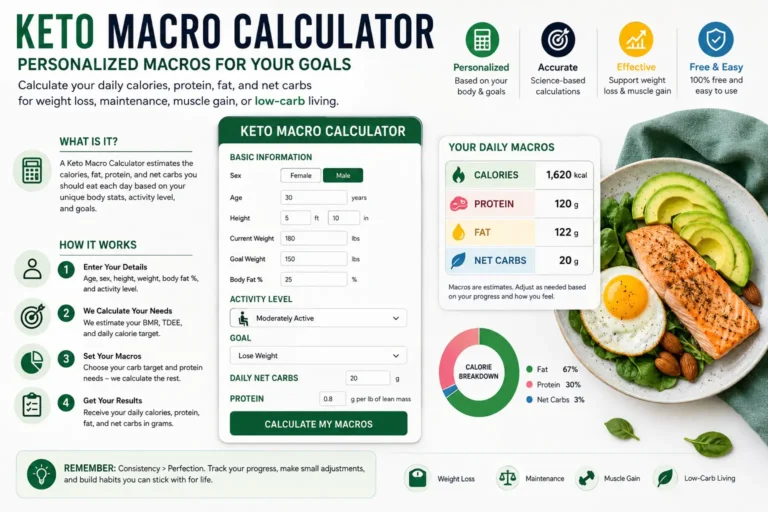
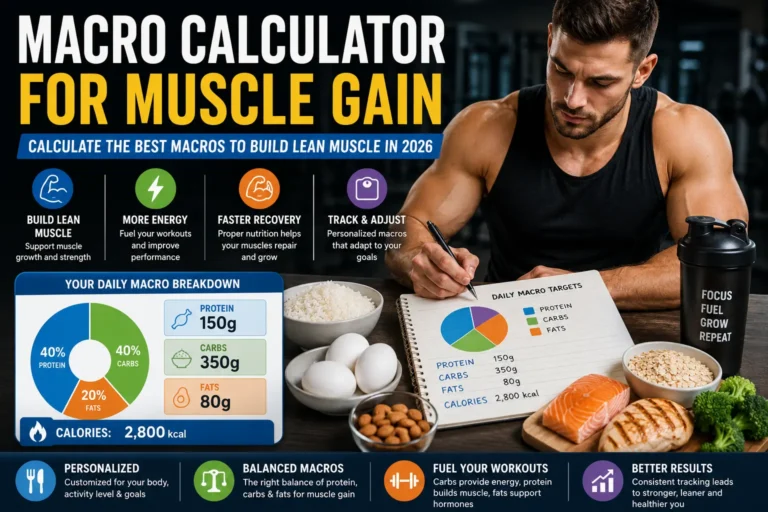
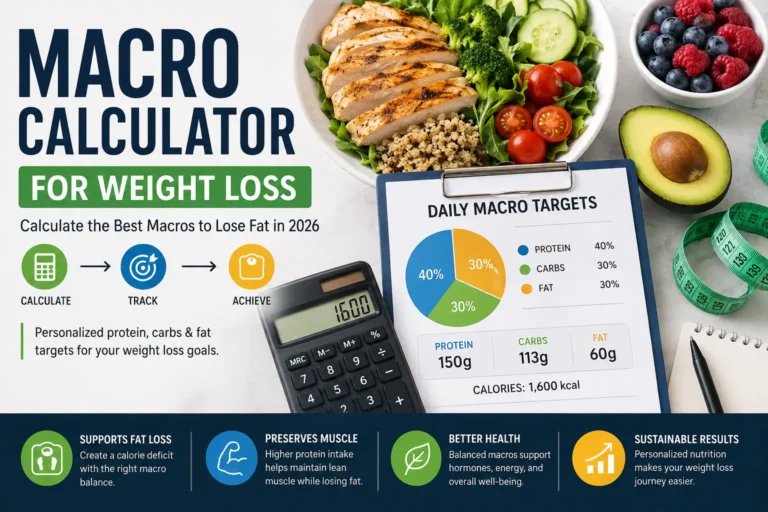
What Is a Good Macro Ratio for Body Recomp?
There is no single macro ratio that works perfectly for every person attempting body recomposition.
You may see approaches such as:
- 40% carbohydrates / 30% protein / 30% fat
- 40% protein / 40% carbohydrates / 20% fat
- Higher-protein, moderate-carbohydrate approaches
- Higher-carbohydrate approaches for demanding training schedules
These percentages can be useful examples, but they should not replace individualized calculations.
Protein requirements are generally better considered in relation to body weight, while fat and carbohydrate intake can then be adjusted according to calories, preferences, training demands, and dietary tolerance.
The supplied source similarly recommends establishing calorie and protein targets first and then using a macro calculator to divide the remaining calories between carbohydrates and fat.
Should You Eat at Maintenance for Recomp?
Not necessarily.
Body recomposition can occur under different nutritional conditions depending on the individual.
Someone with relatively high body-fat levels and limited resistance-training experience may be able to build muscle while eating around maintenance or in a modest calorie deficit.
A person returning to training after several months away may also respond well because previously developed muscle can be regained relatively quickly.
On the other hand, an experienced lifter who is already lean may find simultaneous muscle gain and fat loss considerably more difficult.
The supplied material identifies beginners, people returning to training, and people whose previous training or nutrition has not been optimized as groups who may have better potential for recomp.
This is one reason a calculator should not be treated as a guarantee. Your starting condition influences the likely outcome.
Body Recomp Requires Resistance Training
Nutrition alone will not create the best possible body recomposition result.
Resistance training provides the stimulus that tells your body that muscle tissue needs to be maintained or developed.
A good program should include consistent resistance exercises and progressive improvement over time.
Depending on your experience and program, this could include:
- Squats
- Deadlifts
- Rows
- Pull-ups
- Bench presses
- Overhead presses
- Lunges
- Leg presses
- Curls
- Triceps exercises
You do not necessarily need a special “recomp workout.”
The supplied research material emphasizes that body recomposition training is largely about applying fundamental training principles consistently, including sufficient effort, appropriate volume, and regular training of major muscle groups.
The quality of your training matters more than finding a magical exercise combination.
Don’t Ignore Sleep and Recovery
Nutrition and training receive most of the attention, but recovery can have a significant influence on results.
Sleep supports normal recovery and helps you maintain the energy required to train consistently.
The supplied research discussion describes a 2020 study in which improved sleep was associated with better fat-loss outcomes compared with training alone. It recommends aiming for at least seven hours of sleep per night.
That does not mean sleeping more will automatically cause fat loss. Rather, good sleep should be considered one component of a broader lifestyle that includes appropriate nutrition and training.
How to Track Your Recomp Progress
One of the biggest challenges with body recomposition is that body weight alone does not tell the entire story.
Imagine your scale stays at 75 kg for several months. That might appear to mean nothing has happened.
But if you have lost several kilograms of fat while gaining a similar amount of muscle, your body composition has improved substantially despite little change in scale weight.
For this reason, track multiple measurements.
1. Body Weight
Weigh yourself under similar conditions and look at the weekly average rather than becoming concerned about individual daily fluctuations.
2. Waist Measurement
A decreasing waist measurement can be a useful sign that body fat is being reduced.
3. Progress Photos
Take photos under similar lighting, clothing, posture, and distance from the camera.
4. Strength
Record your major lifts and watch for gradual improvements in performance.
5. How Your Clothes Fit
Changes in waist size, shoulders, legs, and overall fit can provide useful information that the scale misses.
The supplied source specifically recommends looking at progress photos, gym strength, clothing fit, and waist circumference when evaluating recomp progress.
How Often Should You Adjust Your Macros?
Avoid changing your macros every few days.
Your body needs time to respond to a consistent nutrition and training plan.
Instead, monitor your results for several weeks and look for a clear trend.
If your waist measurement is gradually decreasing, strength is stable or improving, and your overall physique is improving, there may be no reason to make a major change.
If nothing is changing after a reasonable observation period, you can reassess your calorie intake, activity, training quality, sleep, and adherence.
Remember that calculated calorie needs are estimates. Your real-world results provide additional information that can help you refine the plan.
Common Body Recomp Macro Mistakes
Eating Too Few Calories
A huge calorie deficit may produce faster scale-weight loss, but it can also make training and recovery more difficult.
Not Eating Enough Protein
Protein should be treated as a priority rather than whatever remains after carbohydrates and fats are calculated.
Changing Macros Constantly
Frequent changes make it difficult to determine whether your original plan was actually working.
Focusing Only on the Scale
Muscle gain can offset some of the weight lost from fat, making scale weight a poor standalone measure.
Neglecting Resistance Training
Trying to achieve recomposition through diet and cardio alone misses an important part of the muscle-building equation.
Expecting Fast Results
Body recomposition is usually slower and more subtle than a conventional bulk or cut.
Macro Calculator for Recomp vs. Cutting or Bulking
Your nutritional targets should reflect your primary goal.
Cutting
The main objective is reducing body fat. A calorie deficit is normally the central factor, while adequate protein and resistance training help support muscle retention.
Recomp
The objective is to improve body composition by reducing fat while maintaining or gaining muscle. Calories are often closer to maintenance or involve a modest deficit, depending on the individual.
Lean Bulking
The objective is primarily muscle gain. A controlled calorie surplus can provide additional energy to support growth.
The supplied source explains that people who are already relatively lean and have trained consistently for at least six months may find recomp more difficult and may benefit more from focusing specifically on muscle gain or fat loss depending on their priority.
Frequently Asked Questions
How many calories should I eat for body recomposition?
There is no universal number. Start by estimating your maintenance calories and then select an appropriate calorie target based on your body composition, training experience, and goal. A modest deficit may be appropriate for some people.
How much protein do I need for recomp?
A practical starting range is around 0.8 grams per pound of body weight, with higher intake sometimes useful during a calorie deficit. Individual requirements can vary.
Should carbs or fats be higher?
Neither is automatically better. Once protein and calories are established, carbohydrates and fats can be adjusted according to training demands, preferences, and dietary needs.
Can beginners build muscle and lose fat simultaneously?
Yes. Beginners can have particularly good potential for body recomposition because their bodies are responding to a new resistance-training stimulus.
Do I need to hit my macros perfectly every day?
No. Consistency over time matters more than achieving an exact number every single day. Small variations are normal and should not cause unnecessary stress.
How long does body recomposition take?
There is no fixed timeline. Results depend on starting body composition, training experience, calorie intake, protein consumption, recovery, and consistency. Because changes can be gradual, measuring several indicators is more useful than expecting dramatic weekly transformations.
Final Thoughts
A macro calculator for body recomposition can provide a useful starting framework for determining how many calories, grams of protein, carbohydrates, and fats to consume each day. But the calculator itself is not the complete strategy.
Successful recomposition depends on putting those numbers into practice through consistent nutrition, progressive resistance training, adequate recovery, and realistic expectations.
Start by determining your calorie needs, prioritize adequate protein, allocate dietary fat appropriately, and use carbohydrates to support your remaining energy requirements. Then monitor your waist, body weight, strength, photos, and overall performance over time.
Most importantly, avoid chasing perfection. A sensible plan that you can follow consistently will usually be more useful than a complicated macro split that looks perfect on paper but is difficult to maintain.
When used as a starting point rather than a promise of guaranteed results, a macro calculator for body recomp can make the nutrition side of body recomposition much easier to understand and manage.