Macro Calculator for Muscle Gain: Calculate the Best Macros to Build Lean Muscle in 2026
Building muscle is not simply about spending more time in the gym. Resistance training provides the stimulus your muscles need to grow, but your daily nutrition determines whether your body has enough energy and nutrients to recover and build new tissue.
A well-planned diet should provide enough calories to support training, sufficient protein for muscle repair, carbohydrates to fuel workouts, and dietary fats for overall health. However, determining exactly how much of each nutrient you need can be confusing.
A Macro Calculator for muscle gain provides a practical starting point by estimating your calorie and macronutrient requirements based on factors such as age, sex, height, weight, activity level, and goal.
Whether you’re starting a lean bulk, trying to gain muscle without adding excessive body fat, or simply want a more structured nutrition plan, a macro calculator can help turn general fitness advice into daily targets.
Quick Answer
A Macro Calculator for Muscle Gain estimates your daily calorie, protein, carbohydrate, and fat requirements for gaining muscle. A common approach is to first estimate maintenance calories, then add a modest calorie surplus while keeping protein sufficiently high and using carbohydrates and fats to complete the remaining calorie target.
For many people, approximately 1.6–2.2 grams of protein per kilogram of body weight per day is a useful evidence-based range for supporting muscle growth. A moderate calorie surplus, rather than aggressive overeating, can help limit unnecessary fat gain during a muscle-building phase.
Key Takeaways
- Muscle growth requires resistance training plus adequate nutrition.
- A calorie surplus can support muscle gain when maintenance calories are exceeded.
- Protein provides the amino acids required for muscle repair and growth.
- Carbohydrates help fuel demanding resistance-training sessions.
- Dietary fats support normal hormonal and physiological functions.
- A starting macro target should be adjusted according to real-world progress.
- Your calorie and macro needs can change as your body weight and training routine change.
- Calculators provide estimates rather than perfectly precise individual requirements.
What Is a Macro Calculator for Muscle Gain?
A muscle gain macro calculator is an online nutrition tool that estimates how many calories and macronutrients you should consume each day when your goal is to increase muscle mass.
Instead of following the same calorie target as someone else, the calculator uses your personal information to create a more individualized starting point.
Most calculators consider:
- Age
- Sex
- Height
- Current body weight
- Physical activity
- Exercise frequency
- Weight or muscle-building goal
Depending on the calculator, the result may include:
- Estimated maintenance calories
- Muscle-gain calorie target
- Daily protein target
- Daily carbohydrate target
- Daily fat target
The purpose is not to produce a perfect number. Your actual energy needs can vary because of factors such as metabolism, training intensity, daily movement, sleep, and changes in body weight. Instead, the calculator gives you a practical baseline that you can monitor and adjust.
Why Macros Matter for Muscle Growth
Calories provide the energy your body needs, but calories alone don’t tell you whether your diet contains enough protein, carbohydrates, and fat.
Macronutrients have different roles in a muscle-building diet.
Protein
Protein is particularly important because it supplies amino acids needed for muscle protein synthesis and tissue repair.
Common high-protein foods include:
- Chicken breast
- Turkey
- Lean beef
- Fish
- Eggs
- Greek yogurt
- Cottage cheese
- Milk
- Whey protein
- Tofu
- Tempeh
- Lentils
- Beans
For many people who regularly perform resistance training, a daily intake around 1.6–2.2 g/kg of body weight is a practical target range.
More protein is not automatically better. Once your protein intake is adequate, overall calorie intake, training quality, recovery, and dietary consistency become increasingly important.
Carbohydrates
Carbohydrates are the body’s major readily available fuel source for many forms of high-intensity exercise.
They can help replenish muscle glycogen and support performance during demanding workouts.
Useful carbohydrate sources include:
- Rice
- Oats
- Potatoes
- Sweet potatoes
- Whole-grain bread
- Whole-grain pasta
- Quinoa
- Beans
- Fruits
- Cereals
If your training volume is high, adequate carbohydrate intake can make it easier to maintain workout intensity and recover between sessions.
Dietary Fats
Dietary fat should not be eliminated during a muscle-building phase. Fat contributes to normal physiological functions and helps the body absorb fat-soluble vitamins.
Good sources include:
- Avocado
- Olive oil
- Nuts
- Seeds
- Nut butters
- Eggs
- Salmon
- Sardines
Rather than focusing on a rigid percentage for everyone, use your calorie target and minimum nutritional needs to create a balanced diet that you can maintain.
How Does the Muscle Gain Macro Calculator Work?
A typical macro calculator uses several steps to estimate your daily nutrition requirements.
Step 1: Estimate Your Basal Metabolic Rate
Your Basal Metabolic Rate (BMR) represents the approximate amount of energy your body requires at rest to support essential functions such as breathing, circulation, and organ activity.
BMR is influenced by factors including:
- Age
- Sex
- Height
- Body weight
Your BMR is not your total daily calorie requirement because you burn additional calories through movement and exercise.
Step 2: Estimate Total Daily Energy Expenditure
Your Total Daily Energy Expenditure (TDEE) estimates how many calories you use throughout the day.
TDEE generally accounts for:
- Resting energy expenditure
- Walking and daily movement
- Exercise
- Digestion
- Other physical activity
This is why two people with the same body weight may require different calorie intakes.
A person who performs resistance training five times per week and has an active job may require considerably more energy than someone with a sedentary lifestyle.
Step 3: Add a Moderate Calorie Surplus
Muscle gain generally benefits from having enough energy available to support training and recovery.
Instead of dramatically increasing calories, many people use a moderate surplus of around 200–300 calories per day as a starting point for a lean-gaining approach.
The appropriate surplus depends on the individual.
If body weight is not increasing after several weeks and training performance is stable, calories may need to increase. If weight is rising much faster than expected and body-fat accumulation becomes excessive, the calorie surplus may be too large.
Step 4: Set Your Protein Target
Protein is usually established before carbohydrates and fats because of its importance for muscle repair and growth.
A commonly used range for people who lift weights is approximately:
1.6–2.2 g of protein per kg of body weight per day
For example, someone weighing 75 kg could start with approximately 120–165 grams of protein per day, depending on their circumstances and overall diet.
Step 5: Set Dietary Fat
Once protein is established, an appropriate amount of dietary fat can be included to support a balanced diet.
The remaining calories can then be allocated primarily toward carbohydrates, particularly when training performance and workout volume are priorities.
Step 6: Use Carbohydrates to Complete Your Calories
After protein and fat targets are established, carbohydrates can fill much of the remaining calorie budget.
This approach is often useful for lifters because carbohydrates can support training intensity and replenish glycogen.
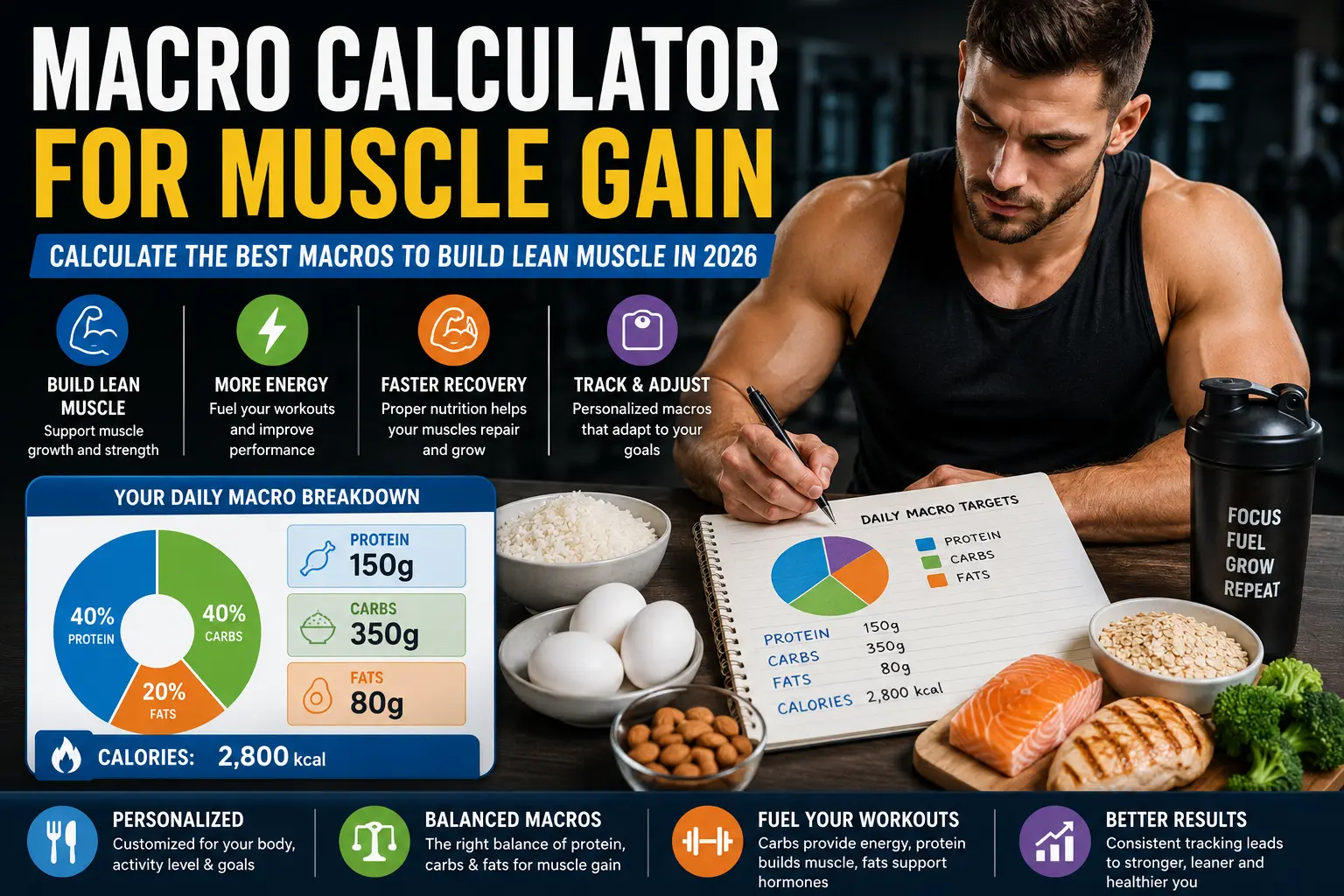
Example of a Muscle Gain Macro Calculation
Consider a hypothetical person with:
- Weight: 75 kg
- Maintenance calories: 2,500 kcal
- Goal: Lean muscle gain
- Training: Regular resistance training
A starting calorie target might be around 2,700–2,800 calories, depending on the person’s circumstances and chosen surplus.
Protein could be set around 150 g, providing 600 calories.
Fat could be set around 75 g, providing 675 calories.
If the total target were 2,750 calories:
- Protein: 150 g = 600 calories
- Fat: 75 g = 675 calories
- Remaining calories: 1,475
- Carbohydrates: approximately 369 g
This is only an example. Your actual macro targets should be calculated from your own calorie requirements rather than copying another person’s numbers.
How Much Protein Do You Need to Build Muscle?
One of the most common questions in muscle-building communities is how much protein is enough.
Current fitness discussions frequently use a range around 1.6–2.2 g/kg/day for resistance-trained individuals.
For someone weighing:
| Body Weight | 1.6 g/kg | 2.2 g/kg |
| 60 kg | 96 g | 132 g |
| 70 kg | 112 g | 154 g |
| 80 kg | 128 g | 176 g |
| 90 kg | 144 g | 198 g |
| 100 kg | 160 g | 220 g |
These figures are starting points rather than mandatory numbers. Individual requirements can vary based on training status, body composition, total calorie intake, food preferences, and other factors.
Is 40/30/30 a Good Macro Split for Bulking?
A 40/30/30 split means:
- 40% of calories from carbohydrates
- 30% from protein
- 30% from fat
It can work for some people, but there is no universal macro ratio that guarantees muscle growth.
A percentage-based approach can also produce an unnecessarily high protein intake for some individuals while leaving less room for carbohydrates.
For muscle gain, it is generally more useful to:
- Establish your calorie target.
- Set an adequate protein intake.
- Include enough dietary fat.
- Allocate the remaining calories according to your training and personal preferences.
This makes your nutrition plan more flexible than following a fixed 40/30/30 rule.
Benefits of Tracking Macros for Muscle Gain
Using personalized macro targets can make your nutrition easier to manage.
Better Calorie Consistency
Tracking calories gives you a clearer idea of whether you’re actually eating enough to support your goal.
Adequate Protein
A macro target makes it easier to notice when your daily protein intake is consistently too low.
Better Workout Fuel
Carbohydrate targets can help ensure that your diet provides enough energy for demanding training sessions.
Controlled Weight Gain
Tracking calories can help prevent the common mistake of turning a lean bulk into an aggressive bulk with unnecessary fat gain.
Easier Adjustments
Your targets can be modified as your weight, training volume, and goals change.
How to Track Your Progress During a Bulk
Your calculator result is only the starting point.
After setting your calorie and macro targets, monitor your progress for several weeks.
Useful metrics include:
- Weekly average body weight
- Strength progression
- Workout performance
- Waist measurement
- Progress photos
- Recovery
- Hunger and energy levels
Daily body weight can fluctuate because of hydration, food volume, sodium, glycogen, and other factors. Looking at a weekly average provides a more useful picture than reacting to a single weigh-in.
If your weight is not changing over several weeks, you may need a small calorie adjustment.
If you’re gaining weight rapidly and noticing substantial increases in body fat, reducing the calorie surplus may be appropriate.
Macro Calculator vs. Calorie Calculator
| Feature | Calorie Calculator | Macro Calculator |
| Estimates daily calories | Yes | Yes |
| Estimates protein | Usually no | Yes |
| Estimates carbohydrates | Usually no | Yes |
| Estimates fats | Usually no | Yes |
| Supports muscle-gain planning | Limited | Yes |
| Personalized nutrition targets | Basic | More comprehensive |
| Helps structure daily food intake | Limited | Yes |
A calorie calculator primarily answers “How many calories should I eat?”
A macro calculator goes one step further by estimating how those calories can be distributed between protein, carbohydrates, and fats.
Who Should Use a Muscle Gain Macro Calculator?
A muscle gain calculator can be useful for:
- Beginners starting resistance training
- People planning a lean bulk
- Experienced gym users
- Bodybuilders
- Athletes
- People transitioning from a fat-loss phase
- Individuals who struggle to estimate their calorie needs
- Lifters who want a structured starting point
It can also be useful for people who have previously followed generic meal plans but want targets based more closely on their own body size and activity level.
Macro Calculator for Muscle Gain and Fat Loss
Some people want to build muscle while reducing body fat, often described as body recomposition.
This goal is different from a traditional bulk.
Instead of automatically creating a large calorie surplus, a person pursuing recomposition may focus on:
- Adequate protein
- Progressive resistance training
- Sufficient recovery
- Calories around maintenance or a modest deficit
- Consistent tracking
The best approach depends on factors such as training experience, current body composition, and individual goals.
If your primary goal is maximum muscle gain, a controlled surplus may be more appropriate. If reducing body fat is equally important, a maintenance or modest-deficit strategy may make more sense.
How Often Should You Adjust Your Muscle Gain Macros?
You do not need to change your macros every few days.
Instead, give your starting targets enough time to produce a meaningful trend.
Consider reviewing your plan when:
- Your body weight has changed significantly.
- Your training volume increases.
- Your activity level changes.
- Your progress has stalled for several weeks.
- You are gaining weight faster than intended.
- Your goal changes from muscle gain to maintenance or fat loss.
A calculator should be treated as a dynamic starting point rather than a permanent prescription.
Common Muscle Gain Macro Mistakes
Eating Too Many Calories
A huge calorie surplus does not automatically mean faster muscle growth. Excess calories can increase fat gain.
Not Eating Enough Protein
A person may consume plenty of calories but still struggle to meet their protein target.
Cutting Carbohydrates Too Low
Very low carbohydrate intake can make high-volume resistance training more difficult for some people.
Following Someone Else’s Macros
Your friend’s calorie and macro targets may be completely different from yours.
Changing Targets Too Frequently
Constantly changing your calorie intake makes it difficult to determine what is actually working.
Ignoring Training
Nutrition supports muscle growth, but progressive resistance training remains a key stimulus for building muscle.
Frequently Asked Questions
How do I calculate my macros for muscle gain?
Start by estimating your maintenance calories or TDEE, then add a modest calorie surplus. Set protein around 1.6–2.2 g/kg of body weight, establish an appropriate fat intake, and use carbohydrates to provide the remaining calories.
What are the best macros for muscle gain?
There is no single ratio that works for everyone. Adequate protein, sufficient calories, enough dietary fat, and enough carbohydrates to support training are more important than following a rigid percentage split.
How many calories should I eat to gain muscle?
Your calorie requirement depends on your body size, activity level, metabolism, and current weight. A modest surplus above maintenance is commonly used for controlled muscle gain.
Can I gain muscle without a calorie surplus?
Muscle gain is possible without a traditional surplus in some circumstances, particularly for beginners, people returning to training, or individuals with higher body-fat levels. However, a modest surplus can make gaining muscle easier for many experienced lifters.
Is 1 gram of protein per pound enough for muscle gain?
For many people, 1 gram per pound of body weight is already within or near a high-protein range. The commonly used evidence-based range of approximately 1.6–2.2 g/kg/day corresponds to about 0.7–1.0 g/lb/day.
Should I change my macros as I gain weight?
Yes. As your body weight and activity requirements change, your calorie and macro needs may also change. Periodic reassessment can keep your nutrition plan aligned with your current goal.
Final Thoughts
Building lean muscle requires more than simply eating more food. Your training, calorie intake, protein consumption, carbohydrate availability, dietary fats, sleep, and recovery all contribute to your results.
A Macro Calculator for Muscle Gain can give you a useful starting point by converting your personal information into estimated calorie and macronutrient targets. From there, the most important step is monitoring your real-world progress and making gradual adjustments when necessary.
For most people, the goal should not be to find a “perfect” macro number. Instead, focus on a sustainable calorie surplus, adequate protein, productive resistance training, consistent recovery, and a diet you can follow for months rather than days.
Use the Macro Calculator to estimate your starting calorie and macro targets. A Macro Calculator for Muscle Gain can then help you understand whether your daily protein, carbohydrates, and fats are aligned with your muscle-building goal. Track your weight, performance, and body-composition changes over time to determine whether your plan is working.
Disclaimer: Macro calculators provide estimates and should not be considered individualized medical or nutritional advice. People with medical conditions, specific dietary requirements, or concerns about nutrition should consult a qualified healthcare or nutrition professional.