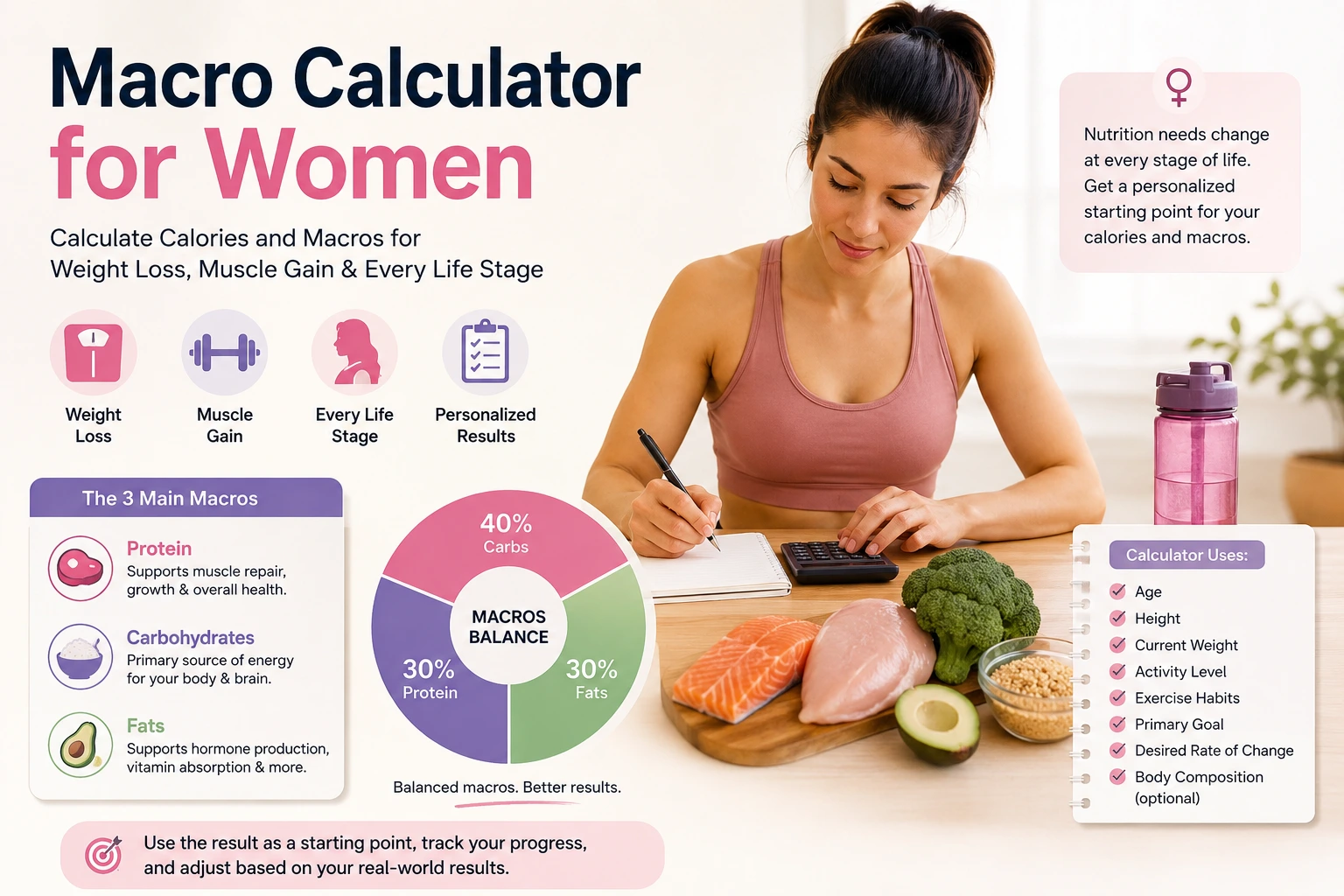
Macro Calculator for Women: Calculate Calories and Macros for Weight Loss, Muscle Gain & Every Life Stage
A woman’s nutrition needs are not always the same as another woman’s. Age, height, weight, activity level, muscle mass, goals, pregnancy, breastfeeding, menopause and certain health conditions can all influence how much energy and protein she may need.
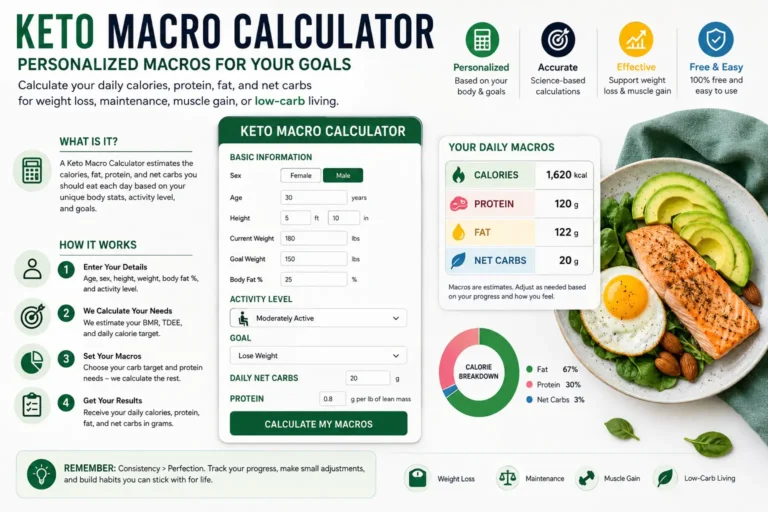
That is why a Macro Calculator for Women can be a useful starting point. Instead of looking only at calories, a macro calculator estimates how those calories can be divided between protein, carbohydrates and dietary fat.
Use the calculator above to estimate your daily calories and macros based on your personal information and goal. Then use the result as a starting point rather than treating it as a perfect prescription. Energy-needs equations are estimates, and your real-world weight trend, activity and performance can provide valuable information for adjusting your targets over time.
For women, that distinction is especially important because nutrition needs can change across different stages of life.
What Is a Macro Calculator for Women?
A women’s macro calculator estimates your daily calorie and macronutrient needs using information such as:
- Age
- Sex
- Height
- Current body weight
- Activity level
- Exercise habits
- Primary goal
- Desired rate of weight change
- Sometimes body-fat percentage or lean body mass
The three main macronutrients are protein, carbohydrates and fat.
Protein provides amino acids needed for maintaining and repairing tissues. Carbohydrates provide an important source of energy, particularly during higher-intensity exercise. Dietary fat supplies energy and supports several essential body functions, including the absorption of fat-soluble vitamins.
A calculator combines these inputs to create a practical starting target.
However, there is no single “perfect” macro ratio for every woman. The right starting point for a sedentary woman trying to maintain her weight can be very different from the starting point for a strength-training woman trying to gain muscle.
Women also have different nutritional considerations at different life stages. The Office on Women’s Health notes that women have unique nutritional needs, particularly across different stages of life.
How Does a Women’s Macro Calculator Work?
Most calculators follow a similar process.
Step 1: Estimate Basal Metabolic Rate
Your BMR, or basal metabolic rate, is an estimate of the energy your body requires at rest.
A commonly used equation is the Mifflin-St Jeor equation. Your age, body weight, height and sex are used to estimate your resting energy expenditure.
For example, the equation for women is commonly represented as:
BMR = (10 × weight in kg) + (6.25 × height in cm) − (5 × age) − 161
This is an estimate, not a laboratory measurement.
Step 2: Estimate Total Daily Energy Expenditure
Your BMR does not represent everything you burn during a normal day.
Your TDEE, or Total Daily Energy Expenditure, accounts for factors such as:
- Walking
- Work and daily movement
- Exercise
- Training
- Digestion
- General physical activity
A calculator usually applies an activity multiplier to your estimated BMR.
This is one reason selecting the correct activity level matters. Someone who works at a desk, walks 3,000 steps and rarely exercises will have different energy needs from someone who walks 10,000 steps and strength trains four times per week.
Step 3: Apply Your Goal
Your calorie target can then be adjusted according to your objective.
Common goals include:
Fat loss: A calorie deficit is created.
Weight maintenance: Calories are kept around estimated maintenance.
Muscle gain: Calories may be increased to support training and tissue growth.
Body recomposition: Calories may be kept closer to maintenance while protein and resistance training are emphasized.
The important point is that the calculator produces a starting estimate. Your actual progress should eventually help determine whether that starting point needs adjustment.
How Many Calories Does a Woman Need?
There is no universal calorie number for women.
Two women who are the same age can have very different energy requirements because of differences in height, weight, muscle mass, daily movement and exercise.
For example, a 25-year-old woman who is 5’2″ and works from home may require considerably fewer calories than a 25-year-old woman who is 5’8″, works on her feet and strength trains five days per week.
This is why searching for a fixed number such as “1,500 calories for women” can be misleading.
A better approach is to calculate an individualized starting estimate and then monitor the trend.
The Office on Women’s Health similarly emphasizes that women can lose and gain weight differently and that healthy-weight strategies need to account for individual circumstances.
What Should a Woman’s Macros Be?
There is no single macro ratio that works for every woman.
A practical starting point should consider total calories, adequate protein, dietary fat and carbohydrate needs, rather than blindly copying someone else’s percentages.
A common general framework is to prioritize:
- Appropriate calorie intake for your goal
- Adequate protein
- Sufficient dietary fat
- Remaining calories from carbohydrates according to preference and activity
This approach gives you more flexibility than trying to force every woman into the same 30/40/30 or 40/40/20 formula.
Protein
Protein is particularly important when a woman is trying to preserve or build lean muscle.
Good protein sources include:
- Eggs
- Chicken
- Fish
- Greek yogurt
- Cottage cheese
- Milk
- Lean meat
- Tofu
- Tempeh
- Lentils
- Beans
- Other protein-rich foods
Women who resistance train may have different protein needs from sedentary individuals. Protein can also become especially useful during calorie restriction because maintaining adequate protein and resistance training can help support lean mass.
Carbohydrates
Carbohydrates are not automatically “bad” for fat loss.
They can provide fuel for walking, running, resistance training and other physical activities.
Useful carbohydrate sources include:
- Oats
- Rice
- Potatoes
- Sweet potatoes
- Whole grains
- Beans
- Lentils
- Fruit
- Vegetables
Instead of eliminating carbohydrates, many women can adjust the amount according to their calorie target, activity and food preferences.
Dietary Fat
Dietary fat is another essential part of a balanced eating pattern.
Sources include:
- Avocado
- Nuts
- Seeds
- Olive oil
- Fatty fish
- Nut butters
- Eggs
The goal is not to eliminate fat simply because you are trying to lose body fat.
Macro Calculator for Women for Weight Loss
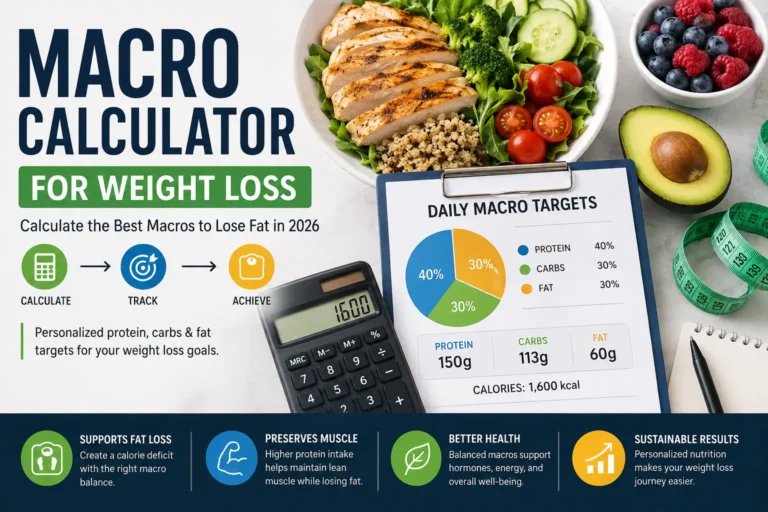
For women whose goal is fat loss, the calculator can provide an estimated calorie target and macro distribution.
But the number on the calculator should not become an obsession.
A sensible process is:
Calculate → follow consistently → track the trend → evaluate → adjust if necessary.
Daily scale weight can fluctuate because of water, food volume, sodium, carbohydrate intake and hormonal changes. A single weigh-in therefore does not tell you whether your nutrition plan is working.
Looking at a longer trend can be much more useful.
The Office on Women’s Health recommends focusing on healthy eating patterns and sustainable changes rather than simply chasing rapid weight loss.
What If the Scale Stops Moving?
First, don’t immediately assume that your metabolism has “stopped.”
Check:
- Your average weight trend
- Food-tracking accuracy
- Portion sizes
- Weekend intake
- Exercise consistency
- Daily steps
- Sleep
- Menstrual-cycle-related changes
- Recent changes in training
- Water retention
If the trend has genuinely stalled for several weeks despite consistent adherence, your calorie or activity strategy may need to be reviewed.
This is where real-world data becomes more useful than repeatedly switching between different online calculators.
Female Fat Loss Macros: What Actually Matters?
A common mistake is to search for a magical female fat loss macro ratio.
There isn’t one.
The most important variables are the overall calorie deficit, adequate protein, food quality, adherence and resistance training when appropriate.
A woman who enjoys higher carbohydrates may distribute her calories differently from a woman who prefers more dietary fat. Both approaches can potentially work if the overall nutritional plan supports the goal.
The best plan is usually the one you can follow consistently while meeting your nutritional requirements.
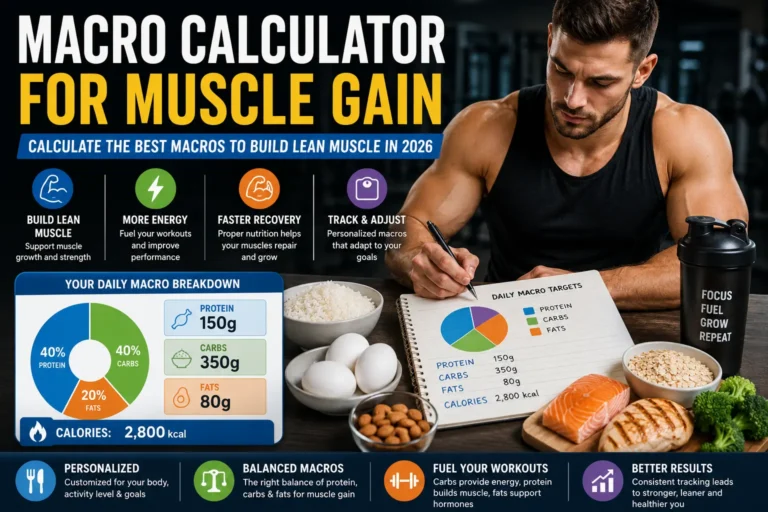
Macro Calculator for Women and Muscle Gain
Women can absolutely use a macro calculator for muscle-building goals.
If you strength train consistently, nutrition needs to support recovery and training performance.
For muscle gain, consider:
- Adequate total calories
- Sufficient protein
- Enough carbohydrates to support training
- Adequate dietary fat
- Progressive resistance training
- Sufficient sleep and recovery
You don’t need to dramatically increase calories simply because you want more muscle.
A controlled approach can make it easier to monitor changes in body weight, strength and body composition.
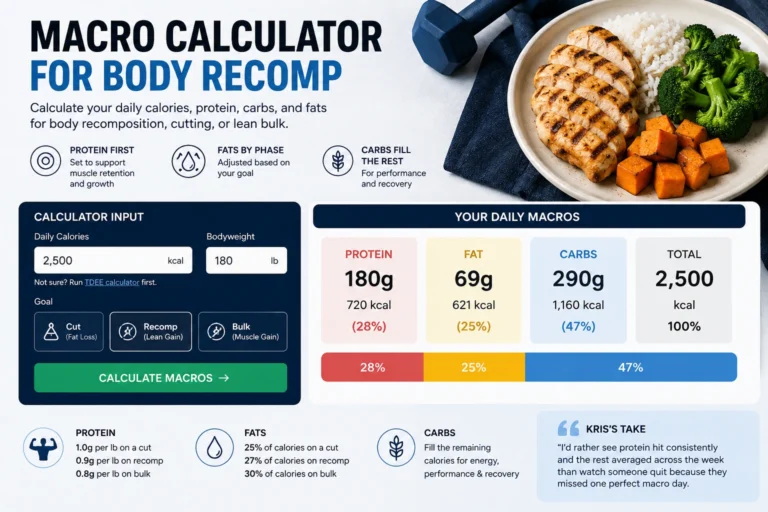
Macro Calculator for Body Recomposition
Body recomposition means trying to improve the ratio of lean mass to body fat rather than focusing exclusively on scale weight.
This can be particularly appealing to women who say:
“I don’t necessarily want to weigh much less. I want to look stronger and leaner.”
In that situation, the scale may not tell the whole story.
Track several indicators:
- Body weight trend
- Waist or other measurements
- Strength in the gym
- Progress photos
- Clothing fit
- Training performance
Resistance training and adequate protein can be especially useful components of a recomposition-focused plan.
Menopause Macro Calculator: Do Women Need Different Macros After Menopause?
Menopause is one of the most important areas to consider when creating a women-focused nutrition resource.
However, menopause does not mean that every woman suddenly needs a completely different macro ratio.
Instead, changes in body composition, activity, appetite, lifestyle and energy expenditure may influence individual calorie requirements.
A menopause-focused nutrition strategy can emphasize:
- Adequate protein
- Fiber-rich foods
- Nutrient-dense carbohydrates
- Healthy dietary fats
- Resistance training
- Regular movement
- Sleep
- Sustainable calorie intake
Women should also avoid assuming that every change in weight or body composition is simply a matter of “hormones.”
Individual health history matters, and persistent or concerning symptoms should be discussed with an appropriate healthcare professional.
Breastfeeding Macro Calculator: Why Calories Are Different
Breastfeeding is a situation where a standard weight-loss calculator should not simply be used without considering additional nutritional needs.
According to the CDC’s March 2026 guidance, well-nourished breastfeeding mothers generally need about 330 to 400 additional calories per day compared with their pre-pregnancy intake, although needs vary with factors such as age, BMI, activity level and whether breastfeeding is exclusive or combined with formula feeding.
That means a breastfeeding woman should not automatically take a normal fat-loss calorie target and apply a large deficit.
Nutrition during breastfeeding also involves more than calories. Adequate nutrients, fluids and overall dietary quality matter for maternal health and breastfeeding.
If you are breastfeeding and want to lose weight, work with your doctor or a registered dietitian for an individualized plan.
Pregnancy Nutrition Guide: Should You Use a Macro Calculator?
Pregnancy is another situation where a standard macro calculator should not be treated as a personalized medical nutrition plan.
Pregnancy changes nutritional requirements, and calorie needs vary according to factors including the stage of pregnancy and individual circumstances.
The American College of Obstetricians and Gynecologists continues to provide dedicated nutrition guidance for pregnancy, including healthy eating and preparation before pregnancy.
If you’re pregnant, don’t use a generic calculator to create an aggressive calorie deficit.
Instead, discuss calorie, protein, weight-gain and nutrient needs with your obstetrician, midwife or qualified dietitian.
PCOS Macros: Is There a Special PCOS Macro Ratio?
There is no universally accepted “PCOS macro ratio” that every woman with polycystic ovary syndrome should follow.
PCOS is a complex condition, so nutrition needs to be individualized.
A practical approach can focus on:
- Adequate protein
- High-fiber foods
- Nutrient-dense carbohydrates
- Healthy fats
- Appropriate calorie intake
- Regular physical activity
- Sustainable eating habits
The Office on Women’s Health notes that healthy eating and regular physical activity can help improve some PCOS-related outcomes, including blood glucose management and insulin sensitivity.
If you have PCOS, diabetes, take glucose-lowering medication or have another medical condition, get individualized advice before making major dietary changes.
Hormones and Macros: What Women Should Know
Searches for “hormones and macros” often produce overly complicated claims.
The reality is more nuanced.
Hormones can influence appetite, fluid balance, menstrual cycles, body composition and other aspects of health. But that doesn’t mean you need to completely change your macros every few days based on your cycle.
For most women, consistency is more useful than micromanagement.
A sensible nutrition plan can remain relatively stable while you monitor:
- Hunger
- Energy
- Training performance
- Menstrual-cycle changes
- Weight trends
- Recovery
- Overall wellbeing
If you experience significant menstrual changes, unexplained weight changes or other concerning symptoms, seek professional medical advice rather than trying to solve the issue through macro adjustments alone.
How Menstrual-Cycle Changes Can Affect Your Macro Tracking
One reason women’s weight tracking can feel confusing is that body weight can fluctuate during the menstrual cycle.
Temporary changes in water retention can make the scale move independently of changes in body fat.
This means a woman could follow her nutrition plan accurately and still see the scale rise temporarily.
Instead of reacting to every daily change, compare trends over an appropriate period and consider where you are in your cycle.
This is another reason a good macro calculator should be viewed as a starting point, not a daily command.
How to Adjust Your Macros When Your Results Don’t Match Your Goal
A calculator cannot know exactly how your body will respond.
Suppose your initial target produces a calorie intake that you can follow consistently. After several weeks, your average weight trend may show that you’re losing faster or slower than intended.
That’s useful information.
Rather than immediately switching to another calculator, consider reviewing:
If fat loss is slower than expected
Check your tracking accuracy first.
Then evaluate your activity and average calorie intake before making a modest adjustment.
If fat loss is much faster than intended
You may need to increase calorie intake, particularly if you notice excessive fatigue, poor training performance, persistent hunger or difficulty recovering.
If your weight is stable but your strength is improving
Don’t automatically assume the plan has failed.
For someone pursuing body recomposition, stable weight with improvements in strength, measurements or body composition can be a positive outcome.
How Much Protein Should Women Eat?
Protein requirements depend on factors such as body size, activity, age and goal.
Instead of automatically using a “one gram per pound” rule for everyone, consider the person’s overall circumstances.
For active women, especially those who strength train or are dieting, adequate protein becomes particularly important.
Useful protein-rich foods include both animal and plant options, so your macro target does not require a particular diet style.
A vegetarian or vegan woman can build a high-protein diet using foods such as tofu, tempeh, lentils, beans, soy foods and other protein-rich choices.
Best Foods for Hitting Women’s Macro Targets
You don’t need a complicated meal plan to hit your macros.
Protein foods
- Chicken breast
- Turkey
- Fish
- Eggs
- Greek yogurt
- Cottage cheese
- Lean beef
- Tofu
- Tempeh
- Lentils
- Beans
Carbohydrate foods
- Oats
- Rice
- Potatoes
- Whole-grain bread
- Quinoa
- Fruit
- Beans
- Lentils
- Vegetables
Healthy fat sources
- Avocado
- Olive oil
- Nuts
- Seeds
- Nut butter
- Fatty fish
The Office on Women’s Health recommends making sustainable healthy changes rather than trying to overhaul everything at once.
Macro Tracking Does Not Replace Food Quality
Hitting your numbers is not the same thing as having a nutritious diet.
For example, two meals could contain similar calories and macros but provide very different amounts of fiber, vitamins, minerals and other beneficial compounds.
A better approach is to use macros as one layer of your nutrition strategy.
Prioritize a varied diet containing:
- Vegetables
- Fruits
- Whole grains
- Legumes
- Protein-rich foods
- Healthy fats
- Adequate fluids
Then use your macro targets to guide quantities.
Should Women Count Macros Every Day?
Not necessarily.
Some women enjoy tracking because it gives them structure. Others find it stressful or overly restrictive.
Macro tracking can be useful when you are learning portion sizes, trying to reach a specific protein target or working toward a particular fitness goal.
But if tracking food becomes obsessive or negatively affects your relationship with eating, it may not be the right approach.
Nutrition should support your life rather than take it over.
Macro Calculator for Women vs. Calorie Calculator
A calorie calculator estimates how much energy you may need.
A macro calculator goes one step further by estimating how those calories can be distributed between protein, carbohydrates and fat.
For example:
Calorie calculator:
Estimated daily energy = 2,000 calories
Macro calculator:
Protein = 140 g
Carbohydrates = 215 g
Fat = 65 g
The exact numbers depend on the calculator’s methodology and your selected inputs.
Neither number should be interpreted as a laboratory measurement.
Why Your Calculator Result May Not Match Another Calculator
It’s normal for two calculators to produce different results.
They may use:
- Different BMR equations
- Different activity multipliers
- Different assumptions about exercise
- Different calorie-deficit settings
- Different protein formulas
- Different body-composition assumptions
That doesn’t automatically mean one calculator is broken.
The more important question is whether the starting estimate is reasonable and whether your real-world results give you enough information to make sensible adjustments.
How to Use a Macro Calculator More Accurately
For a better starting estimate:
1. Enter your current measurements accurately
Use your current weight and height rather than outdated numbers.
2. Be realistic about activity
Don’t choose “very active” because you exercise three times per week if most of your day is spent sitting.
Daily movement matters too.
3. Choose one primary goal
Select fat loss, maintenance, muscle gain or recomposition based on what you actually want.
4. Follow the target consistently
A calculator cannot evaluate your results if your intake changes dramatically from weekday to weekend.
5. Track trends
Don’t make major decisions based on one morning’s scale reading.
6. Adjust based on evidence
Your actual trend can eventually become more useful than an initial mathematical estimate.
Women’s Nutrition Needs Change Across Life Stages
One of the biggest limitations of generic macro calculators is that women are not nutritionally identical throughout their lives.
A teenage athlete, a woman in her 20s, a woman trying to conceive, a pregnant woman, a breastfeeding mother and a postmenopausal woman can have very different considerations.
That is why this topic naturally connects with several specialized searches:
- Macro Calculator for Women
- Menopause Macro Calculator
- Breastfeeding Macro Calculator
- Pregnancy Nutrition Guide
- PCOS Macros
- Female Fat Loss Macros
- Hormones and Macros
These should not be treated as interchangeable calculators.
Instead, they represent different search intents and different nutritional contexts.
What Makes a Good Macro Calculator for Women?
A useful calculator should do more than output three numbers.
Ideally, it should explain:
- What the calorie estimate means
- How BMR is calculated
- How activity affects TDEE
- How the goal changes calorie intake
- How protein is determined
- How carbohydrates and fat are allocated
- Why results are estimates
- When the calculator should not be used
- When professional advice is appropriate
That transparency is important because users should be able to understand why they received a result rather than simply being handed a number.
A Better Way to Think About “Accurate” Macros
The word accurate can be misleading.
A calculator can perform its mathematical formula perfectly while still producing an imperfect estimate of your actual energy requirements.
Think of your result as a starting hypothesis:
“Based on these inputs, this calorie and macro target is a reasonable place to begin.”
Then your real-world data helps test that hypothesis.
This approach is especially useful because energy expenditure can vary between individuals even when they have similar height, weight, age and activity levels.
What Reddit Discussions Get Right About Macro Tracking
Fitness and nutrition communities frequently debate which calculator is best, but a recurring practical lesson is more important than the brand of calculator.
Users often recommend:
- Setting protein first
- Using calories as the larger framework
- Tracking body-weight trends instead of individual days
- Making small adjustments
- Avoiding constant calculator-hopping
- Accounting for water-weight fluctuations
- Choosing a method that can actually be followed
That practical feedback aligns with a broader principle: the best calculator is not necessarily the one producing the most complicated output. It is the one that gives you a sensible starting point and helps you make better decisions.
Frequently Asked Questions
What is the best macro calculator for women?
The best macro calculator is one that clearly explains its methodology, considers your individual inputs and gives you a practical starting point. No calculator can perfectly predict your individual energy expenditure.
How do I calculate my macros as a woman?
Start by estimating BMR, account for activity to estimate TDEE, adjust calories for your goal and then distribute calories between protein, carbohydrates and fat. After several weeks, use your real-world progress to determine whether adjustments are needed.
What are good macros for female fat loss?
There is no universal female fat-loss ratio. A sustainable calorie deficit, adequate protein, appropriate dietary fat and enough carbohydrates to support your activity are more useful principles than copying a fixed percentage split.
Should women eat more protein when trying to lose fat?
Adequate protein can be particularly important during fat loss, especially for active women and those who resistance train. Your exact target depends on your body size, activity and circumstances.
Is there a special macro calculator for menopause?
A menopause-focused calculator can provide a useful starting estimate, but menopause does not automatically require one universal macro ratio. Nutrition, activity, muscle mass, body composition and individual health factors all matter.
Can I use a macro calculator while breastfeeding?
A standard calculator should not automatically be used to create an aggressive calorie deficit during breastfeeding. The CDC states that well-nourished breastfeeding mothers generally require an additional 330 to 400 calories per day compared with pre-pregnancy intake, with individual needs varying.
Can I use a macro calculator during pregnancy?
Pregnancy requires specialized nutritional consideration. A generic weight-loss calculator should not be used to create a calorie deficit during pregnancy. Discuss your nutrition and weight-gain needs with your healthcare professional.
Are PCOS macros different?
There is no single macro ratio that works for every woman with PCOS. A balanced, nutrient-dense eating pattern, appropriate activity and individualized calorie and protein targets may be more useful than following a rigid PCOS ratio.
Why does my weight change even when I hit my macros?
Scale weight can change because of water, food volume, sodium, carbohydrate intake, exercise and menstrual-cycle-related fluctuations. Look at trends rather than reacting to every individual weigh-in.
Should I change my macros every week?
Usually, no. Constantly changing your targets can make it difficult to determine what is actually working. Give a consistent approach enough time to produce useful trend data before making changes.