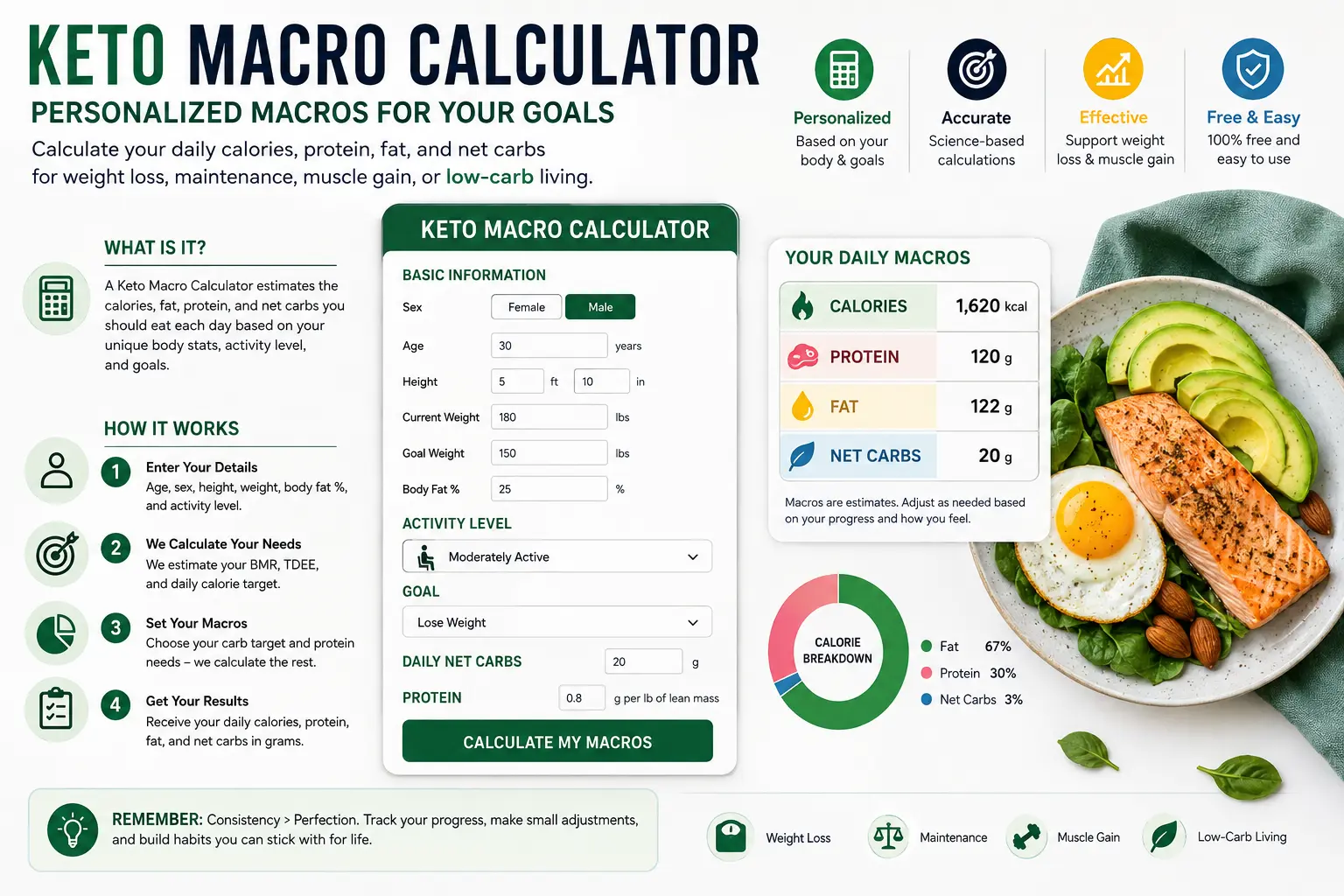
Keto Macro Calculator (+ Low Carb, + Free Keto)
Starting a ketogenic or low-carb diet can feel simple at first: reduce carbohydrates, choose better foods, and eat enough protein and fat. The difficult part is figuring out how much you should actually eat each day.
Your calorie and macro needs are different from someone else’s because they depend on factors such as age, sex, height, weight, activity level, body composition, and your goal.
A Keto Macro Calculator can take those factors into account and give you a practical daily target for calories, protein, fat, and net carbohydrates. Instead of relying on a generic 70/25/5 keto ratio or guessing how much fat to add to your meals, you can start with numbers that are more relevant to your body and objective.
This guide explains how a keto macro calculator works, how to calculate keto macros manually, how many net carbs you may need, how protein and fat fit into the plan, and how to use your results for weight loss, maintenance, muscle gain, and low-carb eating.
Important: A macro calculator provides an estimate, not a medical diagnosis or prescription. Individual nutritional needs vary. If you are pregnant, breastfeeding, taking medication, managing diabetes or another medical condition, or under medical supervision, speak with an appropriately qualified healthcare professional before making major dietary changes.
What Is a Keto Macro Calculator?
A keto macro calculator is an online nutrition calculator that estimates how many calories, protein, fat, and carbohydrates you may need each day while following a ketogenic or low-carbohydrate eating pattern.
Instead of giving everyone the same macro ratio, a personalized calculator can consider:
- Age
- Sex
- Height
- Current weight
- Goal weight
- Activity level
- Body fat percentage, when available
- Weight-loss or weight-gain goal
- Desired calorie deficit or surplus
- Daily carbohydrate target
- Protein requirements
- Whether you are active, sedentary, or strength training
The result is usually a daily calorie target plus macro targets in grams.
This matters because keto is not simply about eating as much fat as possible. Calories, protein, carbohydrate intake, food quality, activity, and adherence all influence the outcome.
Research also supports the broader role of carbohydrate restriction for weight management, although outcomes vary between individuals and dietary approaches. A large systematic review and dose-response meta-analysis found an association between greater carbohydrate reduction and greater weight loss at six and 12 months, while longer-term effects were more complex.
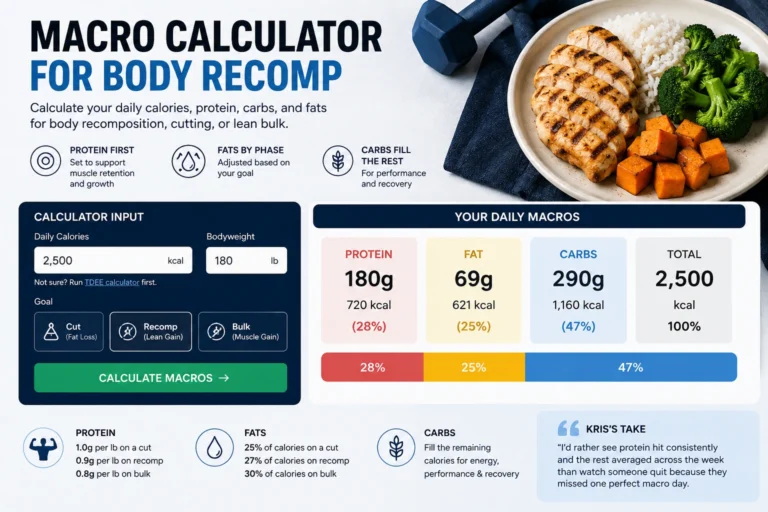
Free Keto Macro Calculator
Use the calculator above to estimate your personalized keto macros.
For the most useful result, enter your information as accurately as possible.
Information you may need
1. Sex
Sex is commonly used in energy expenditure equations because average body composition and energy requirements differ between men and women.
2. Age
Age is another input used when estimating resting energy expenditure.
3. Height and weight
Your height and current weight help establish an estimate of your resting calorie needs.
4. Activity level
Someone who works at a desk and rarely exercises generally requires fewer calories than someone who walks extensively, performs physical labor, or trains several times a week.
5. Body fat percentage
If you know your body fat percentage from a reasonably reliable measurement, it can help estimate lean body mass. However, consumer body-fat measurements can have substantial uncertainty, so do not treat a single reading as exact.
6. Goal
Your target might be:
- Weight loss
- Weight maintenance
- Muscle gain
- Body recomposition
- General low-carb eating
7. Carbohydrate target
You can select a carbohydrate target appropriate for your preferred low-carb or ketogenic approach.
How Does a Keto Macro Calculator Work?
Most calorie and macro calculators follow several basic stages.
Step 1: Estimate BMR
The calculator first estimates your basal metabolic rate (BMR).
BMR represents the energy your body requires to support essential physiological functions at rest.
One commonly used equation is the Mifflin-St Jeor equation.
For men:
BMR = (10 × weight in kg) + (6.25 × height in cm) − (5 × age) + 5
For women:
BMR = (10 × weight in kg) + (6.25 × height in cm) − (5 × age) − 161
These equations provide estimates rather than direct measurements of metabolism.
Step 2: Estimate TDEE
The next step is estimating Total Daily Energy Expenditure (TDEE).
TDEE represents the approximate amount of energy you use throughout the day, including resting metabolism and physical activity.
A simplified approach is:
TDEE = BMR × Activity Factor
For example, someone with a sedentary lifestyle will generally use a lower activity multiplier than someone who exercises frequently.
Step 3: Apply Your Goal
Once estimated maintenance calories are available, the calculator can adjust them according to your goal.
For weight loss:
Target calories = TDEE − calorie deficit
For maintenance:
Target calories ≈ TDEE
For weight gain:
Target calories = TDEE + calorie surplus
A moderate starting adjustment is often easier to sustain than an aggressive one.
Step 4: Set Carbohydrates
Keto generally requires substantially fewer carbohydrates than a conventional diet.
Many ketogenic approaches use around 20–50 grams of net carbohydrates per day, although the amount required to maintain nutritional ketosis can vary.
There is no universal carbohydrate number that guarantees ketosis for every person.
Step 5: Set Protein
Protein helps support muscle tissue and other physiological functions.
A personalized calculator may estimate protein based on body weight, lean body mass, activity level, and goal.
This is particularly important for people who are dieting while resistance training because the goal is not simply to make the number on the scale smaller; preserving lean mass can also matter.
Step 6: Use Fat to Complete Calories
After carbohydrate and protein targets are established, dietary fat can supply the remaining calories.
This is one reason keto macros should be viewed as a calorie and macro system, rather than simply a percentage such as 70% fat, 25% protein, and 5% carbs.
What Are Keto Macros?
“Macros” is short for macronutrients.
There are three major macronutrients:
- Fat
- Protein
- Carbohydrates
Each provides energy.
Fat
Fat provides approximately 9 calories per gram.
On a ketogenic diet, fat often supplies a large proportion of total dietary energy.
Good food choices can include:
- Avocado
- Olive oil
- Eggs
- Fatty fish
- Nuts and seeds
- Cheese
- Full-fat dairy, where appropriate
- Meat and poultry
- Nut butters
However, “keto” does not automatically mean every high-fat food is a good nutritional choice.
Protein
Protein provides approximately 4 calories per gram.
Protein is important for maintaining and repairing tissues and is particularly relevant when trying to preserve muscle during weight loss.
Keto does not mean eliminating protein.
Your ideal intake depends on your body size, lean mass, training, age, health status, and objective.
Carbohydrates
Carbohydrates also provide approximately 4 calories per gram.
On a ketogenic diet, carbohydrate intake is deliberately restricted.
The important distinction is between total carbohydrates and net carbohydrates.
Net Carbs vs. Total Carbs
This is one of the most common questions people have when starting keto.
A commonly used calculation is:
Net carbs = Total carbohydrates − Dietary fiber − applicable sugar alcohols
However, the treatment of individual sugar alcohols can differ, so blindly subtracting all sugar alcohols from every food label is not always appropriate.
For example, if a food contains:
- 15 g total carbs
- 7 g fiber
then:
15 − 7 = 8 g net carbs
Food labels can also differ between countries, so always understand how carbohydrates and fiber are reported where you live.
If your goal is nutritional ketosis, tracking the carbohydrate definition used by your calculator and food-tracking system consistently is more useful than switching between different methods.
How Many Carbs Can You Eat on Keto?
There is no single carbohydrate limit that works identically for everyone.
A commonly used ketogenic target is approximately 20–50 grams of net carbs per day.
Some people may need a lower intake to maintain ketosis, while others may remain in ketosis at a higher intake.
Factors that can influence your response include:
- Individual metabolism
- Activity
- Exercise
- Total calorie intake
- Protein intake
- Carbohydrate sources
- Glycogen stores
- Adaptation to carbohydrate restriction
If your primary objective is weight loss rather than therapeutic ketosis, you should also remember that calorie intake and overall dietary adherence remain important.
A 2025 systematic review and meta-analysis of randomized trials found that ketogenic and low-carbohydrate diets were associated with reductions in body weight, BMI, and body-fat percentage in adults with overweight or obesity, although the studies varied considerably in their interventions and participants.
What Should My Keto Macros Be?
There is no universal keto macro ratio that is perfect for everyone.
A practical starting point is to determine:
- Your calorie requirement
- Your carbohydrate target
- Your protein requirement
- Your remaining calories from fat
For example, imagine your calculator estimates:
1,800 calories per day
and your target is:
- 25 g net carbs
- 120 g protein
- Remaining calories from fat
The calories would be calculated as:
Carbohydrates:
25 × 4 = 100 calories
Protein:
120 × 4 = 480 calories
Calories remaining:
1,800 − 100 − 480 = 1,220 calories
Because fat provides about 9 calories per gram:
1,220 ÷ 9 ≈ 136 g fat
So the approximate daily target would be:
1,800 calories | 25 g net carbs | 120 g protein | 136 g fat
This is only an example to demonstrate the calculation. Your actual targets should come from your own information.
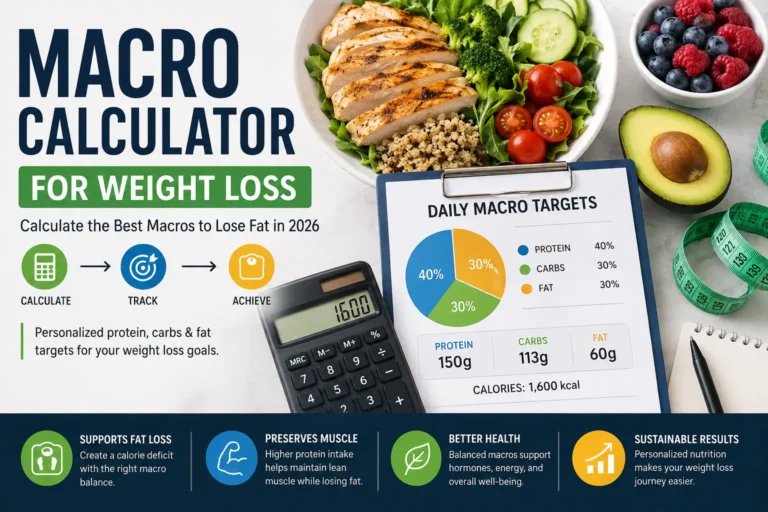
Keto Macros for Weight Loss
If your primary goal is fat loss, your calculator will generally start with an estimated maintenance calorie level and then apply a deficit.
A moderate deficit is often easier to maintain than an extreme restriction.
Your keto weight-loss strategy can therefore look like:
Calories: Moderate deficit
Carbohydrates: Low enough for your chosen keto approach
Protein: Sufficient for your body and activity
Fat: Adjusted to fit your calorie target
One important point is often misunderstood:
Keto does not cancel out calories.
Eating very low carbohydrate foods does not make unlimited calories irrelevant.
Research comparing different macronutrient patterns continues to show that dietary composition matters, but energy intake, adherence, and individual response remain important considerations.
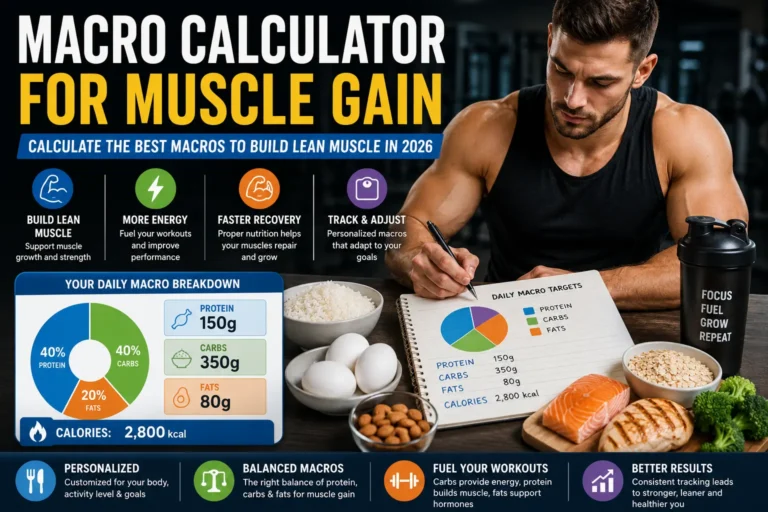
Keto Macros for Muscle Gain
Keto can also be used by people who are interested in maintaining or building muscle, although it requires more attention to training, calories, and protein.
For muscle gain, you generally need:
- Adequate calories
- Sufficient protein
- Progressive resistance training
- Recovery
- Appropriate carbohydrate restriction for your chosen approach
Do not assume that increasing dietary fat indefinitely will automatically produce more muscle.
If your calorie intake is too low, gaining muscle becomes more difficult regardless of whether you eat keto.
For people lifting weights, a calculator may therefore produce a different protein recommendation from that of a sedentary person.
Keto Macros for Maintenance
If you have already reached your preferred weight, you can use the calculator to estimate maintenance calories.
The objective changes from creating a consistent deficit to maintaining energy balance.
Your maintenance macros can still be adjusted according to:
- Training schedule
- Appetite
- Food preferences
- Carbohydrate tolerance
- Body-composition goals
- Lifestyle
A maintenance plan should also be flexible enough to work in real life.
Low-Carb Macro Calculator vs. Keto Macro Calculator
The terms low-carb and keto are often used interchangeably online, but they are not necessarily identical.
A low-carb diet can include substantially more carbohydrate than a ketogenic diet.
For example, someone might reduce carbohydrates significantly while still consuming enough carbohydrate to remain outside nutritional ketosis.
The key difference is the objective.
Keto
The goal is generally to maintain nutritional ketosis through substantial carbohydrate restriction.
Low carb
The goal may simply be to reduce carbohydrate intake without requiring ketosis.
This means a low-carb macro calculator may allow a wider carbohydrate range than a strict keto calculator.
Keto Calculator for Beginners
If you are completely new to keto, do not worry about getting every number perfect on day one.
Start with the basics.
1. Calculate your calories
Find your estimated maintenance calories and choose a sensible goal.
2. Set your carbohydrate limit
Choose a realistic net-carb target.
3. Set protein
Use a protein target appropriate for your body size and activity.
4. Let fat fill the remaining calories
Fat becomes the flexible macro that helps you reach your calorie target.
5. Track what you actually eat
For the first few weeks, food tracking can help you understand portion sizes and hidden carbohydrates.
6. Evaluate your progress
Look at trends rather than a single day’s scale reading.
How to Use Keto Macros in Real Life
A calculator gives you numbers. It does not prepare your meals.
The next step is turning those numbers into food choices.
A simple keto plate can include:
Protein
- Chicken
- Beef
- Eggs
- Fish
- Turkey
- Seafood
Low-carb vegetables
- Spinach
- Broccoli
- Cauliflower
- Zucchini
- Cucumber
- Mushrooms
- Leafy greens
Healthy fat sources
- Avocado
- Olive oil
- Nuts
- Seeds
- Olives
- Fatty fish
The exact combination depends on your calorie and macro targets.
What Foods Are Keto-Friendly?
Foods commonly used in ketogenic meal plans include:
Protein foods
- Eggs
- Chicken
- Turkey
- Beef
- Lamb
- Pork
- Fish
- Shellfish
Low-carb vegetables
- Spinach
- Kale
- Broccoli
- Cauliflower
- Cabbage
- Zucchini
- Cucumber
- Asparagus
Fat sources
- Avocado
- Olive oil
- Avocado oil
- Butter
- Nuts
- Seeds
- Nut butter
Dairy
Depending on tolerance and individual dietary needs:
- Cheese
- Greek yogurt with appropriate carbohydrate content
- Cream
- Cottage cheese
Foods commonly limited on strict keto
- Sugar
- Candy
- Soft drinks
- Bread
- Rice
- Pasta
- Most cereals
- Potatoes
- Large portions of high-sugar fruit
- Sugary sauces
Food quality still matters even when carbohydrate intake is low.
How Do I Know If My Keto Macros Are Working?
Do not judge your plan by the scale alone.
Monitor several signals:
- Body-weight trend
- Waist measurement
- Workout performance
- Hunger
- Energy
- Recovery
- Sleep
- Adherence
- How consistently you are hitting your targets
Early weight loss on keto can also include changes in body water because carbohydrate restriction affects glycogen and associated water storage.
That means a dramatic first-week scale change should not automatically be interpreted as pure body-fat loss.
What If My Weight Loss Stops?
A plateau does not automatically mean keto has stopped working.
First check:
Are you tracking portions accurately?
Small amounts of oils, sauces, cheese, nuts, cream, and snacks can add substantial calories.
Are your maintenance calories still realistic?
Your energy needs can change as body weight and activity change.
Are you actually following your macro targets?
A diet can be low-carb while still being calorie-dense.
Has your activity changed?
A reduction in daily movement can influence energy expenditure.
Have you given the plan enough time?
Daily weight fluctuates because of water, food volume, sodium, bowel contents, hormones, and other factors.
Look at a trend rather than one weigh-in.
What If I Am Eating Less Fat Than My Calculator Recommends?
This is a surprisingly common question.
On a ketogenic diet, dietary fat is not necessarily a target that you must force-feed yourself to reach under every circumstance.
If your goal is weight loss, fat can function as the variable that fills the remaining calorie requirement.
For example, if you are satisfied, meeting your protein target, keeping carbohydrates within your chosen range, and maintaining an appropriate calorie intake, you may not need to add large quantities of extra fat simply to hit a percentage.
However, consistently eating far below your estimated energy needs is a different situation.
Extremely restrictive diets can be difficult to sustain and may create nutritional problems.
Is More Protein Bad on Keto?
This is one of the biggest misconceptions surrounding keto.
Protein is not the enemy.
Your protein requirement should be based on your individual needs rather than internet claims that everyone must follow one fixed percentage.
People who strength train may require more protein than sedentary individuals.
The practical question is not:
“How little protein can I eat while staying keto?”
It is:
“How much protein supports my body composition and performance goals while fitting my chosen carbohydrate and calorie intake?”
If maintaining muscle is important, especially during a calorie deficit, adequate protein and resistance training deserve serious attention.
Can You Do Keto Without Counting Macros?
Yes.
You can follow a low-carb or ketogenic eating pattern without weighing every ingredient.
However, counting macros can be useful when you have a specific goal.
Tracking is particularly helpful if:
- Your weight has plateaued
- You are unsure how many carbs you eat
- You are new to keto
- You want predictable calorie intake
- You are trying to gain muscle
- You want to compare your actual intake with your calculated target
Once you understand portions and your typical foods, you may decide to track less frequently.
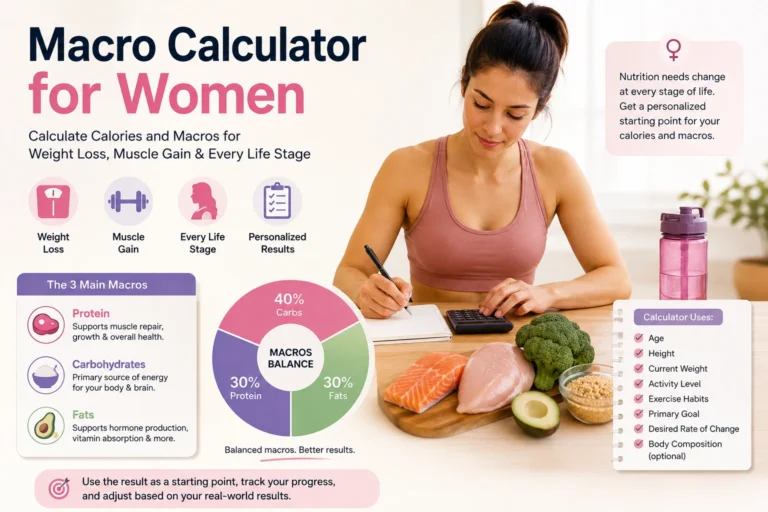
Keto Macro Calculator for Women
Women should not simply use a smaller version of a generic men’s keto plan.
Energy requirements can differ because of body size, body composition, age, activity, and other factors.
A personalized calculator should therefore use the individual’s information rather than assigning the same calorie or macro target to every woman.
For women who are pregnant or breastfeeding, aggressive calorie restriction and ketogenic dieting should not be approached as a standard weight-loss strategy without professional guidance.
Keto Macro Calculator for Men
Men also need individualized calculations.
A larger, highly active man can have dramatically different energy and protein requirements from a smaller sedentary man.
Your calculator should therefore account for:
- Height
- Weight
- Age
- Activity
- Body composition
- Goal
This is why a generic “2,000 calorie keto plan” may be too much for one person and too little for another.
Keto for Active People and Athletes
Your activity level matters.
Someone who walks 3,000 steps per day has a very different energy expenditure from someone who trains for two hours and works a physically demanding job.
If you exercise regularly, consider tracking:
- Training days
- Rest days
- Daily steps
- Workout performance
- Hunger
- Recovery
Some advanced calculators may provide different calorie targets for active and rest days.
This approach can be useful when your weekly activity varies significantly.
Keto and Calories: Why Both Matter
One of the biggest mistakes beginners make is believing that carbohydrate restriction makes calorie intake irrelevant.
It does not.
If you consistently consume more energy than your body uses, weight gain can occur even when carbohydrate intake is low.
If you consume less energy than you use, weight loss can occur.
Keto can make calorie control easier for some people because protein, fat, and low-carb whole foods may improve satiety, but individual responses vary.
The best macro plan is therefore one you can follow consistently while meeting your nutritional needs.
What Is the Best Keto Macro Ratio?
There is no single ratio that is best for everyone.
A traditional ketogenic pattern is often described as high fat, moderate protein, and very low carbohydrate.
But percentages can be misleading because grams and calories are not the same thing.
For example:
- 1 g fat = 9 calories
- 1 g protein = 4 calories
- 1 g carbohydrate = 4 calories
Therefore, 100 grams of protein and 100 grams of fat are not equivalent in calorie contribution.
This is why a personalized macro calculator should provide grams as well as calories.
How Accurate Is a Keto Macro Calculator?
A calculator can be useful, but “accurate” does not mean it can predict your exact metabolism.
The formulas estimate energy requirements from population-level relationships.
Your actual expenditure can differ because of:
- Genetics
- Body composition
- NEAT (non-exercise activity)
- Exercise
- Sleep
- Adaptation
- Hormonal factors
- Measurement error
- Changes in body weight
Think of your calculator result as a starting estimate.
Then use real-world progress to determine whether the estimate needs adjustment.
Keto Macro Calculator vs. Calorie Calculator
A calorie calculator primarily estimates your energy requirements.
A keto macro calculator goes one step further by distributing those calories between:
- Fat
- Protein
- Net carbohydrates
For someone following keto, this additional information can make meal planning considerably easier.
Instead of knowing only:
“Eat 1,800 calories.”
you might have:
1,800 calories
25 g net carbs
120 g protein
136 g fat
That gives you a framework for building meals.
Keto Macro Calculator vs. IIFYM
IIFYM means If It Fits Your Macros.
Both approaches use calorie and macronutrient targets, but keto places a stronger emphasis on carbohydrate restriction.
With general IIFYM, a person might have a relatively flexible carbohydrate target.
With keto, carbohydrates are deliberately restricted to support the goal of nutritional ketosis.
You can therefore think of keto as a specific macro strategy rather than simply a calorie-counting method.
Common Keto Macro Mistakes
Mistake 1: Eating unlimited fat
Fat is calorie-dense.
Adding butter, cheese, cream, oils, nuts, and fatty sauces to every meal can push calories far beyond your target.
Mistake 2: Eating too little protein
Protein should not be minimized simply because keto is often described as “high fat.”
Mistake 3: Counting total carbs when your plan uses net carbs
Use one consistent tracking method.
Mistake 4: Obsessing over exact percentages
Daily intake will naturally fluctuate.
Hitting a reasonable range consistently is often more practical than trying to hit every gram perfectly.
Mistake 5: Ignoring food quality
Low carbohydrate does not automatically mean nutrient-dense.
Mistake 6: Cutting calories too aggressively
A larger deficit is not automatically a better deficit.
Mistake 7: Changing macros every few days
Give your plan enough time to produce a meaningful trend before making repeated adjustments.
Keto Macros and Long-Term Health
Keto is not automatically healthy or unhealthy simply because it has a low carbohydrate percentage.
The quality of the foods, nutrient adequacy, individual health profile, adherence, and duration all matter.
Recent research has found benefits associated with carbohydrate-restricted diets in some populations, while also highlighting potential concerns. For example, a recent meta-analysis reported improvements in body-composition measures with carbohydrate restriction but also found modest increases in LDL and total cholesterol in some analyses.
That is why a personalized approach is more useful than claiming that keto is universally optimal for everyone.
Who Should Be More Careful With Keto?
People with certain medical conditions or special nutritional needs should not treat an online calculator as a substitute for medical advice.
Speak with a qualified healthcare professional before making major dietary changes if you:
- Take glucose-lowering medication
- Have diabetes
- Are pregnant
- Are breastfeeding
- Have a history of eating disorders
- Have kidney disease
- Have liver disease
- Have another condition requiring a specialized diet
- Are taking medication affected by major dietary changes
Very-low-calorie ketogenic diets are particularly different from ordinary keto diets and should not be confused with a standard self-directed low-carb plan. Clinical protocols for very-low-calorie ketogenic diets involve much more substantial restriction and medical considerations.
2026 Keto Nutrition: What Is Changing?
Keto content in 2026 is becoming less about simplistic “eat fat, avoid carbs” rules and more about personalization, measurable outcomes, food quality, and sustainability.
People increasingly want to know:
- How many calories should I eat?
- How much protein do I need?
- What is my net-carb limit?
- Can I build muscle on keto?
- What should I eat on training days?
- How do I adjust my macros after a plateau?
- Is keto appropriate for my lifestyle?
- Which foods actually fit my macros?
That is where a personalized calculator becomes more useful than a generic keto food list.
How AI Search Is Changing Keto Content in 2026
Google’s search environment has expanded beyond the traditional blue-link results.
AI Overviews and AI Mode can synthesize information from multiple sources, which means high-quality health and nutrition content needs to be particularly clear, trustworthy, original, and well-supported.
Google’s current guidance emphasizes creating unique, satisfying content for people rather than writing generic pages solely to capture search traffic.
Google also states that generative AI can be useful for research and organization, but mass-produced pages that add little value can violate its scaled-content-abuse policies.
For a keto calculator page, that means useful content should answer the actual questions users have:
“What are my macros?”
“How many carbs can I eat?”
“Why is my protein target this high?”
“Why did my calories change?”
“What should I do if I plateau?”
This is stronger than repeatedly inserting the phrase “keto macro calculator.”
Keto and Nutrition Content
Nutrition is a topic where trust matters.
A strong keto calculator page should demonstrate:
Experience
Explain how real users can apply their calculated numbers to meals, shopping, tracking, and daily routines.
Expertise
Use established nutrition concepts, explain equations accurately, and distinguish estimates from measured results.
Authoritativeness
Reference credible scientific literature and make the editorial process transparent.
Trustworthiness
Avoid exaggerated claims such as:
- “Guaranteed ketosis”
- “Lose 20 pounds instantly”
- “Burn unlimited fat”
- “This calculator is 100% accurate”
Instead, explain uncertainty honestly.
This approach is particularly important for health-related content because users may act on the information.
Keto Calculator
A strong page should naturally cover the topic’s related concepts rather than repeating one keyword.
Important semantic topics include:
- Keto macro calculator
- Ketogenic macro calculator
- Low-carb macro calculator
- Free keto calculator
- Keto calorie calculator
- Keto macros
- Keto diet macros
- Net carbs
- Total carbs
- Protein on keto
- Fat on keto
- Ketosis
- Calorie deficit
- Calorie surplus
- BMR
- TDEE
- Lean body mass
- Body fat percentage
- Weight loss
- Muscle gain
- Maintenance calories
- Low-carb diet
- Ketogenic diet
- Macro tracking
- Keto meal planning
These concepts should appear where they genuinely help the reader—not as forced keyword stuffing.
Questions Your Keto Calculator Should Answer
Answer Engine Optimization is especially relevant to calculator pages because users often search in question form.
Examples include:
What is a keto macro calculator?
It estimates your calories, fat, protein, and carbohydrate targets based on personal information and your goal.
How do I calculate my keto macros?
Estimate your calorie needs, select a carbohydrate target, establish an appropriate protein target, and use dietary fat to complete your calorie target.
How many net carbs should I eat on keto?
A common range is approximately 20–50 grams of net carbs per day, but individual requirements for nutritional ketosis vary.
What is the best keto macro ratio?
There is no universal ratio. Your targets should reflect your calorie requirements, carbohydrate goal, protein needs, activity, and objective.
Can I lose weight on keto without counting calories?
Yes, some people lose weight without formally tracking calories, but calorie intake still influences body-weight change. Tracking can make plateaus and portion sizes easier to understand.
Can I build muscle on keto?
Muscle gain is possible, but adequate calories, protein, resistance training, recovery, and individual response all matter.
Localized Keto Nutrition
People do not always search from the same nutritional environment.
Food labels, ingredients, restaurant menus, portion sizes, and commonly available foods differ by country.
For example, a keto meal plan for someone in the United States may not look identical to one for someone in the UK, Australia, Europe, India, or Pakistan.
Localized content can therefore make a calculator more useful by helping users understand:
- Local food labels
- Common local foods
- Grams versus ounces
- Metric versus imperial measurements
- Restaurant portions
- Regional ingredients
- Local grocery options
The underlying macro calculation can remain universal while the practical food guidance becomes more relevant to the user’s location.
How to Adjust Your Keto Macros
Do not change everything at once.
If your weight trend has stalled, first check:
- Your food-tracking accuracy
- Your average calorie intake
- Your carbohydrate intake
- Your protein intake
- Your activity level
- Your sleep and recovery
- Your weekly weight trend
Then make a small, deliberate adjustment if appropriate.
A calculator is a starting point—not a permanent prescription.
As your body weight, activity, or goal changes, your calorie and macro requirements may change too.
How Often Should You Recalculate Keto Macros?
You do not need to recalculate every morning.
Consider reviewing your numbers when there has been a meaningful change in:
- Body weight
- Activity
- Training volume
- Goal
- Body composition
- Lifestyle
For example, someone who loses a substantial amount of weight may have different maintenance needs than when they started.
The best system is:
Calculate → follow → measure → evaluate → adjust.
Frequently Asked Questions
Is a keto macro calculator free?
Many online keto calculators are available for free. A free calculator can provide useful estimates without requiring a paid subscription.
What is the difference between a keto calculator and a regular macro calculator?
A regular macro calculator may provide flexible carbohydrate, protein, and fat targets. A keto calculator generally prioritizes a much lower carbohydrate intake designed around a ketogenic eating pattern.
How many calories should I eat on keto?
Your calorie target depends on your age, sex, height, weight, activity level, and goal. There is no single calorie number that is appropriate for everyone.
How many grams of fat should I eat on keto?
Your fat target depends on your calorie requirement and protein and carbohydrate targets. Fat commonly supplies the remaining calories after protein and carbohydrate targets are established.
How much protein should I eat on keto?
Protein requirements vary with body size, lean mass, activity, age, and goal. People who strength train may have different requirements from sedentary individuals.
Is 20 grams of carbs enough for keto?
20 grams of net carbs is a commonly used strict ketogenic target, but individual responses vary. Some people can remain in ketosis at higher carbohydrate intakes.
Is 50 grams of carbs keto?
It can be ketogenic for some people, but not everyone will maintain nutritional ketosis at 50 grams of net carbs per day.
Should I count total carbs or net carbs?
If your keto plan specifically uses net carbs, track them consistently using the calculation your system defines. Be aware that food-label conventions differ between countries.
Can keto help with weight loss?
Ketogenic and low-carbohydrate diets can support weight loss for some people. Research suggests carbohydrate restriction can reduce body weight in adults with overweight or obesity, although individual results and long-term adherence vary.
Does keto work without a calorie deficit?
Low-carb eating can influence appetite and food intake, but sustained changes in body weight still depend heavily on energy balance. Keto should not be treated as a way to make calorie intake irrelevant.
Can I use a keto calculator for muscle gain?
Yes. Select a muscle-gain or weight-gain goal if the calculator provides one, and make sure your protein, calorie intake, and resistance-training plan support the objective.
Can I use the calculator for low-carb instead of strict keto?
Yes, if the calculator allows you to customize your carbohydrate target. Low-carb does not necessarily require the same carbohydrate restriction as ketogenic dieting.
Why are my keto calories higher than my friend’s?
Calories depend on individual characteristics such as body size, age, sex, activity, body composition, and goal. Your numbers do not need to match someone else’s.
Why did my keto calculator give me a high fat target?
Fat is calorie-dense and is commonly used to supply the remaining energy after carbohydrate and protein targets have been established.
What happens if I eat less fat than my calculator recommends?
If you are trying to lose weight, eating somewhat less fat can simply reduce your total calorie intake. However, consistently under-eating by a large amount may make it harder to meet nutritional and energy needs.
Can I eat more protein on keto?
You can adjust protein according to your individual needs, but there is no reason to deliberately consume excessive amounts. Your protein target should fit your body composition, activity, calories, and goal.
Do I need to hit my macros exactly every day?
No. Food intake naturally varies. Aim for consistency over time rather than treating every gram as a pass-or-fail test.
Is keto healthy for everyone?
No diet is automatically appropriate for everyone. Individual health conditions, medications, nutritional requirements, food preferences, and long-term adherence should be considered.
Bottom Line: Use Your Keto Macros as a Starting Point
A Keto Macro Calculator can remove much of the guesswork from ketogenic and low-carb eating.
Instead of copying someone else’s 1,500-calorie meal plan or following a generic macro percentage, you can begin with targets based on your own:
- Age
- Sex
- Height
- Weight
- Activity
- Body composition
- Goal
- Carbohydrate preference
The most useful approach is not to chase perfect numbers.
Calculate your estimated needs, choose a realistic calorie target, keep carbohydrates within your chosen ketogenic range, consume adequate protein, use fat to complete your energy needs, and then evaluate your real-world progress.
Most importantly, remember that a calculator is an estimate. Your body is not a spreadsheet.
Use your results as a starting framework, track your progress over time, and make sensible adjustments as your body, activity, and goals change.
For people who want a free, personalized starting point, the Keto Macro Calculator above can help turn the basic idea of “eat low carb” into practical daily targets for calories, protein, fat, and net carbs.