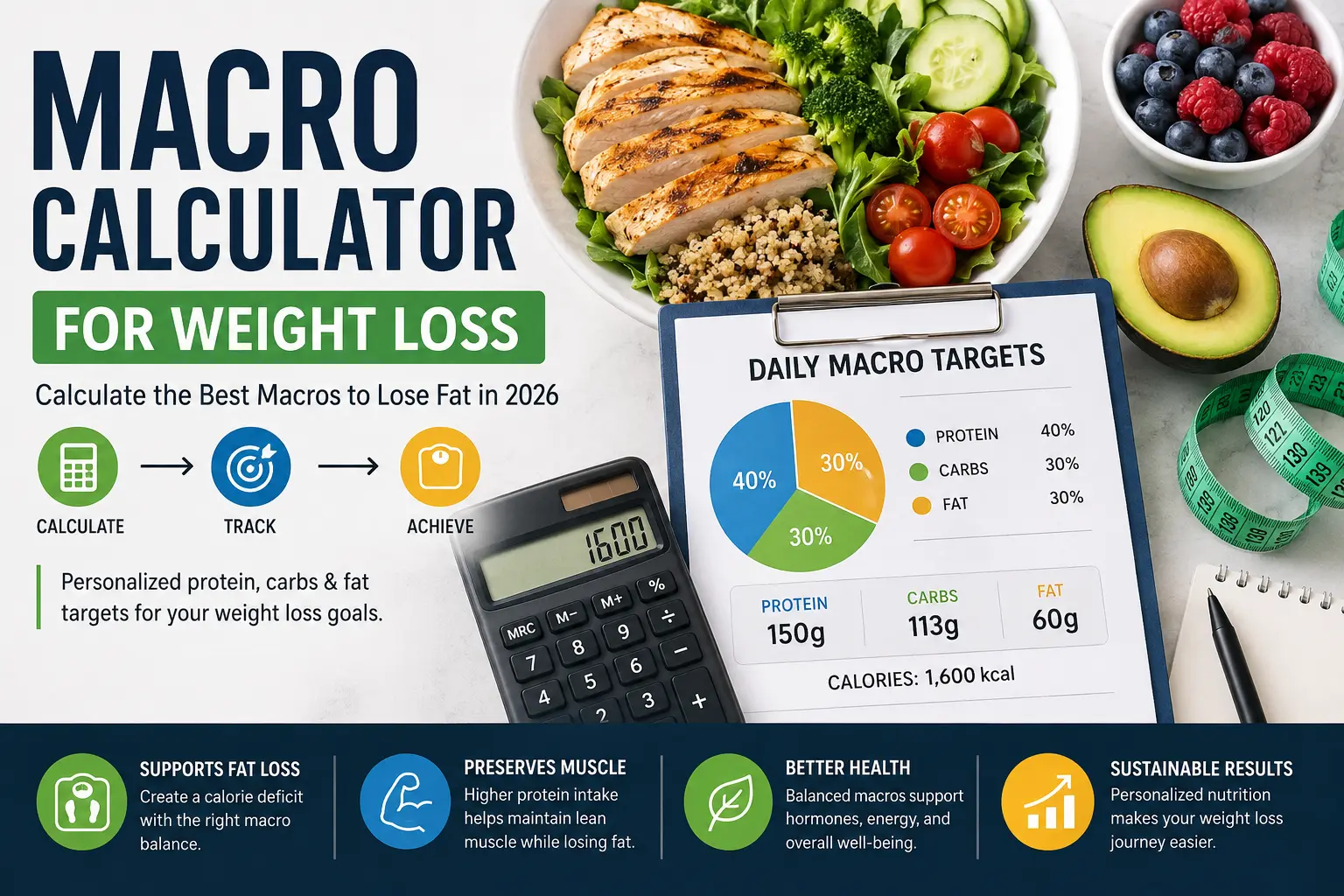
Macro Calculator for Weight Loss: Calculate Your Ideal Macros for Fat Loss in 2026
Losing weight starts with an energy deficit, but successful fat loss involves more than simply choosing a low calorie number. Your protein, carbohydrates, and dietary fat all contribute to how your diet supports energy, training, recovery, hunger, and lean-mass retention.
A Macro Calculator for Weight Loss estimates your daily calorie and macronutrient targets using information such as age, sex, height, current weight, activity level, and weight-loss goal. Instead of copying a generic diet plan, you can use an individualized starting point and then adjust it based on your real-world progress.
This guide explains how a macro calculator works, how calories are estimated, how protein, carbohydrates, and fat are calculated, what macros may look like for different weight-loss goals, and how to adjust your targets when your progress changes.
Important: A macro calculator provides an estimate, not a medical diagnosis or a guarantee of weight loss. Individual energy requirements can vary, and people who are pregnant, breastfeeding, under 18, or managing a medical condition should use personalized guidance from an appropriately qualified healthcare professional.
Quick Answer: What Macros Should I Eat to Lose Weight?
To lose body fat, your calorie intake generally needs to be below your total energy expenditure over time. Your macro targets then divide those calories between protein, carbohydrates, and fat.
There is no single macro ratio that is best for everyone. A practical starting approach is to:
- Estimate your maintenance calories.
- Set a reasonable calorie deficit.
- Prioritize adequate protein.
- Allocate enough dietary fat for nutritional needs.
- Use the remaining calories for carbohydrates.
- Monitor your weight and other progress indicators.
- Adjust the targets when your results consistently differ from your goal.
Higher protein intake during weight loss can help support lean-mass retention. A 2024 systematic review and meta-analysis of 47 studies involving 3,218 adults with overweight or obesity found that increased protein intake significantly reduced muscle-mass decline during weight-loss interventions.
Use the Macro Calculator for Weight Loss
Enter your personal information into the calculator to estimate your daily calorie and macro targets.
Your result is based on factors such as:
- Age
- Sex
- Height
- Current body weight
- Activity level
- Weight-loss goal
- Desired rate of progress
For the most useful result, enter accurate measurements and choose the activity level that best represents your usual weekly activity, rather than selecting a higher level because of occasional intense workouts.
Once you receive your result, use it as a starting target rather than assuming it is an exact measurement of your metabolism.
What Does a Macro Calculator Calculate?
A macro calculator generally estimates two related things:
1. Daily calorie needs
This is an estimate of the energy your body uses each day.
2. Macronutrient targets
Those calories are divided among:
- Protein
- Carbohydrates
- Fat
For example, a hypothetical weight-loss target might look like:
| Nutrient | Example Daily Target |
| Calories | 2,000 kcal |
| Protein | 150 g |
| Carbohydrates | 200 g |
| Fat | 67 g |
This is only an illustrative example, not a universal recommendation. Your actual target should come from your personal calculator results.
What Are Macros?
“Macros” is short for macronutrients. These are nutrients your body needs in relatively large amounts.
The three primary macronutrients are protein, carbohydrates, and fat.
Protein
Protein supplies amino acids that support tissue maintenance and muscle repair.
Protein-rich foods include:
- Chicken
- Turkey
- Fish
- Eggs
- Greek yogurt
- Cottage cheese
- Lean meat
- Tofu
- Beans
- Lentils
- Whey protein
Protein becomes particularly important when you’re eating fewer calories because preserving lean mass is an important part of improving body composition during weight loss. Recent evidence supports the value of higher protein intake for maintaining muscle mass during weight loss.
Carbohydrates
Carbohydrates are an important source of energy, particularly for people who perform resistance training, running, cycling, sports, or other higher-intensity activities.
Carbohydrate sources include:
- Oats
- Rice
- Potatoes
- Sweet potatoes
- Whole-grain bread
- Whole-grain pasta
- Beans
- Fruit
- Vegetables
- Quinoa
You do not have to eliminate carbohydrates to lose weight. Total energy intake, dietary adherence, food quality, and your overall eating pattern matter more than simply labeling carbohydrates as “good” or “bad.”
Dietary Fat
Dietary fat provides energy and helps the body absorb fat-soluble vitamins. It also contributes to cell structure and many physiological processes.
Sources include:
- Avocado
- Olive oil
- Nuts
- Seeds
- Nut butters
- Eggs
- Fatty fish
Fat is calorie-dense, so relatively small portions can contribute substantial calories.
How Does a Macro Calculator Work?
A typical macro calculator follows a series of estimates.
Step 1: Estimate Your BMR
Basal Metabolic Rate (BMR) is an estimate of the energy your body requires at rest to support essential physiological functions.
One commonly used predictive equation is the Mifflin-St Jeor equation, originally published in 1990.
For men:
BMR = (10 × weight in kg) + (6.25 × height in cm) − (5 × age) + 5
For women:
BMR = (10 × weight in kg) + (6.25 × height in cm) − (5 × age) − 161
These equations provide estimates rather than direct measurements. Research comparing predictive equations shows that no formula is perfectly accurate for every individual.
Step 2: Estimate Your TDEE
Your Total Daily Energy Expenditure (TDEE) represents the approximate amount of energy you use throughout a typical day.
It includes more than your resting metabolism. Your daily expenditure is influenced by:
- Resting metabolism
- Physical activity
- Exercise
- Walking and daily movement
- Digestion
- Body composition
- Other individual factors
A calculator commonly estimates TDEE by applying an activity factor to BMR.
Common Activity Categories
| Activity Level | General Description |
| Sedentary | Little structured exercise and mostly sitting |
| Lightly Active | Light exercise or regular movement several days per week |
| Moderately Active | Moderate exercise and regular daily activity |
| Very Active | Frequent intense training or highly active lifestyle |
| Extremely Active | Very demanding training and/or physically demanding work |
Your activity category should reflect your normal routine, not your ideal routine.
Step 3: Create a Calorie Deficit
If your goal is weight loss, you generally need a sustained energy deficit.
For example, if a person’s estimated maintenance intake were 2,400 calories, a hypothetical weight-loss target could be lower than that.
However, there is no reason to assume that a fixed 500-calorie deficit is automatically appropriate for every person.
A suitable calorie target depends on factors including:
- Starting body weight
- Body composition
- Activity level
- Age
- Sex
- Weight-loss history
- Dietary adherence
- Health status
- Individual response
The calculator therefore provides a starting estimate, which should be evaluated against actual progress.
Step 4: Calculate Protein, Fat, and Carbohydrates
After establishing a calorie target, the calories can be distributed among your macros.
Each macronutrient contributes a different amount of energy:
| Macronutrient | Calories per Gram |
| Protein | 4 kcal |
| Carbohydrate | 4 kcal |
| Fat | 9 kcal |
For example, if you consumed 150 grams of protein:
150 × 4 = 600 calories from protein
If you consumed 60 grams of fat:
60 × 9 = 540 calories from fat
The remaining calories can then be allocated to carbohydrates according to the calculator’s methodology.
What Is the Best Macro Ratio for Weight Loss?
There is no universally optimal protein-carb-fat ratio for everyone trying to lose weight.
Two people can successfully lose fat while eating different macro distributions if both maintain an appropriate energy deficit and can consistently follow their diets.
Your ideal distribution may depend on:
- Training style
- Food preferences
- Appetite
- Dietary restrictions
- Protein requirements
- Exercise performance
- Personal adherence
For example, someone who performs frequent strength training may prefer more carbohydrates to support workouts, while another person may prefer a lower-carbohydrate approach because it makes their diet easier to maintain.
The best macro split is therefore usually the one that satisfies nutritional requirements and helps you consistently maintain your calorie target.
How Much Protein Should You Eat for Weight Loss?
Protein deserves particular attention during fat loss because preserving lean mass can help improve body composition.
Research has found that increasing protein intake during weight loss can reduce the decline in muscle mass. A 2024 meta-analysis reported that protein intake above approximately 1.3 g/kg/day was associated with greater muscle-mass preservation in the studied population, while lower intake was associated with greater risk of muscle loss.
However, this should not be interpreted as a universal prescription for every person.
Protein requirements can vary based on:
- Body weight
- Lean mass
- Training status
- Age
- Calorie deficit
- Health status
- Total diet
If you have kidney disease or another medical condition affected by protein intake, discuss your appropriate intake with your healthcare professional.
Macro Calculator for Weight Loss for Women
Women can use the same fundamental calorie and macro principles, but individual calorie requirements vary substantially.
Your results depend on:
- Age
- Height
- Weight
- Activity
- Goal
- Body composition
For example, two women who are both 30 years old can have very different calorie requirements if their heights, weights, activity levels, and training routines differ.
This is why a generic “1,500-calorie female diet” is unlikely to be appropriate for everyone.
For women using a macro calculator:
Focus on:
- Adequate protein
- Nutrient-dense foods
- Sufficient dietary fat
- Appropriate calorie intake
- Fiber-rich carbohydrates
- Resistance training when appropriate
- Sustainable weight-loss habits
Macro Calculator for Fat Loss
“Fat loss” and “weight loss” are often used interchangeably, but they are not exactly the same.
The number on the scale can change because of:
- Body fat
- Muscle
- Water
- Glycogen
- Food in the digestive system
A successful fat-loss strategy aims to reduce excess body fat while maintaining as much lean tissue as reasonably possible.
That makes protein, resistance training, adequate recovery, and a sustainable calorie deficit particularly relevant.
A 2026 systematic review and meta-analysis found that diet-and-exercise weight-loss interventions produced smaller reductions in fat-free mass than several other intervention categories examined, reinforcing the importance of strategies designed to preserve lean tissue.
Macro Calculator for Weight Loss and Muscle Gain
Some people don’t only want to lose weight. They want to lose fat while maintaining or building muscle.
This goal is often called body recomposition.
It may be more achievable for:
- Beginners
- People returning to resistance training
- Individuals with higher body-fat levels
- People who previously had inconsistent training or nutrition
For body recomposition, the focus is usually on:
- Adequate protein
- Progressive resistance training
- Appropriate calorie intake
- Good sleep and recovery
- Consistent nutrition
If muscle gain is your primary goal, you may eventually need a different calorie strategy than someone whose priority is rapid weight loss.
Example: How Macro Targets Can Look
Consider a hypothetical person whose calculator estimates a 2,300-calorie maintenance level.
They might choose a moderate calorie deficit resulting in a 2,000-calorie starting target.
An illustrative macro setup could be:
| Macro | Grams | Calories |
| Protein | 150 g | 600 kcal |
| Fat | 65 g | 585 kcal |
| Carbohydrates | 204 g | 816 kcal |
| Total | — | 2,001 kcal |
This example demonstrates how macros add up; it is not a recommended target for every 2,300-calorie person.
Your own calculator result should be based on your personal inputs.
How to Track Your Macros
Once you know your targets, tracking becomes the next step.
1. Weigh foods when practical
A kitchen scale can improve consistency, especially for calorie-dense foods such as oils, nuts, cheese, and nut butter.
2. Check nutrition labels
Look at:
- Serving size
- Calories
- Protein
- Carbohydrates
- Fat
- Fiber
3. Track cooking ingredients
A meal can be underestimated if you forget:
- Cooking oil
- Sauces
- Dressings
- Sugar
- Cream
- Snacks
4. Focus on daily and weekly consistency
You do not need every meal to be mathematically perfect.
Your overall intake over time matters more than whether one meal is a few grams above or below target.
What Foods Should You Eat for Weight Loss?
A macro target tells you how much protein, carbohydrate, and fat to consume. It does not tell you that every food within those categories has the same nutritional value.
Build most meals around nutrient-dense foods.
Protein
- Chicken
- Fish
- Eggs
- Greek yogurt
- Lean beef
- Beans
- Lentils
- Tofu
Carbohydrates
- Potatoes
- Oats
- Rice
- Fruit
- Vegetables
- Whole grains
- Beans
Fats
- Olive oil
- Avocado
- Nuts
- Seeds
- Fatty fish
A flexible approach can also include foods you enjoy. Long-term adherence is usually easier when a diet fits your lifestyle rather than eliminating every food considered “unhealthy.”
Why Am I Not Losing Weight With My Macros?
If your calculator says you should lose weight but your weight trend has not changed for several weeks, don’t immediately assume your metabolism is “broken.”
Check:
1. Portion accuracy
Small amounts of oils, sauces, drinks, snacks, and high-calorie foods can add up.
2. Activity changes
You may unconsciously move less when eating fewer calories.
3. Water fluctuations
Body weight can change because of hydration, sodium, carbohydrate intake, digestion, and hormonal changes.
4. Time period
A few days is usually not enough to determine whether your plan is working.
5. Calculator assumptions
BMR and TDEE formulas are estimates. Research shows predictive equations have individual errors.
If your weight trend consistently differs from your expected direction, your calorie target may need to be adjusted.
How Often Should You Recalculate Your Macros?
You don’t need to recalculate your macros every day.
Consider reviewing your targets when:
- Your body weight changes substantially.
- Your activity level changes.
- Your training routine changes.
- Your weight-loss progress stalls for a sustained period.
- You reach a new goal phase.
For example, someone who loses a meaningful amount of weight may eventually need a lower calorie intake because their body now requires less energy to maintain its smaller body mass.
Calories vs. Macros: Which Is More Important?
Calories and macros serve different purposes.
| Goal | Calories | Macros |
| Create an energy deficit | Essential | Supportive |
| Set protein intake | Indirect | Direct |
| Support muscle retention | Important | Important |
| Control food quality | Limited | More useful |
| Support workout nutrition | Limited | Useful |
| Track total energy intake | Essential | Also contributes |
Think of calories as the overall energy budget and macros as the nutritional composition of that budget.
Counting macros does not remove the importance of total calorie intake.
Common Macro Tracking Mistakes
Mistake 1: Choosing an Unrealistically Low Calorie Target
Eating as little as possible is not automatically better.
Very restrictive diets can be difficult to sustain and may make it harder to meet nutritional needs.
Mistake 2: Ignoring Protein
If you’re losing weight while doing resistance training, adequate protein deserves attention because of its role in maintaining lean mass.
Mistake 3: Treating the Calculator as Exact
A calculator cannot directly measure your metabolism.
It produces an estimate based on mathematical models.
Mistake 4: Changing Calories Every Few Days
Weight naturally fluctuates. Constantly changing your target can make it difficult to determine whether a strategy is actually working.
Mistake 5: Focusing Only on the Scale
Track more than body weight.
Useful progress indicators include:
- Waist measurement
- Progress photos
- Gym performance
- Clothing fit
- Average weekly weight
- Energy levels
- Consistency
Mistake 6: Believing a Specific Macro Ratio Is Magic
There is no single ratio that causes fat loss.
The calorie deficit remains fundamental, while macro distribution can be adjusted around your nutritional requirements and preferences.
Macro Calculator for Weight Loss: Frequently Asked Questions
What is the best macro calculator for weight loss?
The best macro calculator is one that clearly explains its methodology, uses appropriate inputs, provides transparent results, and allows you to adjust your targets as your body weight and activity change.
Our calculator is designed to estimate daily calories and macronutrient targets from your personal information rather than applying one generic number to everyone.
What are the best macros for weight loss?
There is no single macro ratio that works best for everyone. A good starting plan generally provides adequate protein, sufficient dietary fat, and enough carbohydrates to support your preferred activity level while keeping total calories appropriate for your goal.
How many calories should I eat to lose weight?
Your weight-loss calorie target depends on your estimated maintenance calories and the size of the deficit you choose. Because calorie requirements differ between people, a personalized calculator is more useful than choosing an arbitrary calorie number.
What is the best macro ratio for fat loss?
The best ratio depends on your individual calorie target, protein requirements, activity, food preferences, and ability to maintain the diet. There is no universally superior protein-carb-fat ratio for every person.
Should I count calories or macros?
You can use either approach depending on your goals. Calories determine the overall energy intake, while macros provide information about how those calories are distributed between protein, carbohydrates, and fat. For people interested in body composition, tracking both can provide more useful information.
Can I lose weight without counting macros?
Yes. Macro tracking is a tool, not a requirement. People can lose weight using portion control, structured meal plans, calorie tracking, dietary patterns, or other approaches that help them maintain an appropriate energy intake.
Should I eat more protein while losing weight?
Adequate protein can be particularly useful during weight loss because research suggests higher protein intake can help preserve lean mass. The appropriate amount depends on your individual circumstances.
What macros should women eat to lose weight?
Women should not use one universal macro target. Age, height, body weight, activity level, training, and goals all influence calorie and macro requirements.
Can I lose fat and build muscle at the same time?
It can happen, particularly in beginners, people returning to training, and some individuals with higher body-fat levels. Resistance training, adequate protein, appropriate calorie intake, and recovery are important factors.
How often should I update my macros?
Review your targets when your body weight, activity level, training routine, or goal changes significantly. You don’t need to recalculate them every day.
Why did my weight stop decreasing?
Possible reasons include changes in water weight, reduced activity, tracking errors, changes in calorie requirements as you lose weight, or simply normal short-term fluctuations. Look at your longer-term weight trend before making major changes.
Do I need to cut carbs to lose weight?
No. Fat loss does not require eliminating carbohydrates. Carbohydrate intake can be adjusted based on your calorie target, training needs, preferences, and dietary pattern.
Is a high-protein diet better for weight loss?
Higher protein intake can be useful during weight loss, particularly for supporting lean-mass retention. Evidence from systematic reviews supports an association between increased protein intake and better preservation of muscle mass during energy restriction.
Can I use this calculator for muscle gain?
A weight-loss calculator is designed around a fat-loss goal. If your primary objective is gaining muscle, use a Macro Calculator for Muscle Gain with a calorie target appropriate for that goal.
Can I use a macro calculator for body recomposition?
Yes. Body recomposition requires a different goal strategy from straightforward weight loss. See our Macro Calculator for Body Recomposition to estimate targets designed around losing fat while maintaining or building lean mass.
Weight Loss Is About More Than a Number
A successful weight-loss plan should not be judged solely by how quickly the scale decreases.
A better approach considers:
- Fat loss
- Lean-mass retention
- Strength
- Energy
- Nutrition quality
- Exercise
- Sleep
- Long-term adherence
Recent evidence continues to emphasize the importance of preserving fat-free mass during weight loss. A 2026 meta-analysis found that diet-and-exercise interventions were associated with relatively smaller reductions in fat-free mass than several other weight-loss intervention categories examined.
That is why a sensible macro strategy should support both fat loss and overall body composition rather than simply pushing calories as low as possible.
Related Macro & Nutrition Calculators
Once you know your weight-loss macros, you may also find these tools useful:
- Macro Calculator
- Macro Calculator for Muscle Gain
- Macro Calculator for Body Recomposition
- Macro Calculator for Women
- Keto Macro Calculator
- IIFYM Macro Calculator
- Bodybuilding Macro Calculator
- Carnivore Macro Calculator
- Calorie Calculator
- BMR Calculator
- TDEE Calculator
- Protein Calculator
These tools can be connected through internal links to create a stronger nutrition and macro-calculator topic cluster.
Final Thoughts
A Macro Calculator for Weight Loss gives you a practical starting point for understanding how many calories, grams of protein, carbohydrates, and fat may fit your fat-loss goal.
The calculator should not be treated as an exact measurement of your metabolism. BMR and TDEE are estimates, and real-world energy requirements vary between individuals.
The most effective approach is to use your calculated targets as a starting point, follow them consistently, monitor your longer-term progress, and make gradual adjustments when necessary.
For sustainable fat loss, focus on the bigger picture: an appropriate calorie deficit, adequate protein, nutritious foods, regular physical activity, resistance training when appropriate, sufficient recovery, and habits you can realistically maintain.
Scientific References
- Mifflin MD, St Jeor ST, Hill LA, et al. A new predictive equation for resting energy expenditure in healthy individuals. American Journal of Clinical Nutrition. (PubMed)
- Frankenfield D, Roth-Yousey L, Compher C. Comparison of predictive equations for resting metabolic rate in healthy nonobese and obese adults. Journal of the American Dietetic Association. (PubMed)
- Kokura Y, Ueshima J, Saino Y, Maeda K. Enhanced protein intake on maintaining muscle mass, strength, and physical function in adults with overweight/obesity. Clinical Nutrition ESPEN, 2024. (PubMed)
- Morton RW et al. Evidence examining protein intake above the RDA and lean-mass responses during anabolic and catabolic conditions. (PubMed)
- Recent 2026 systematic review and meta-analysis examining fat-free mass changes across weight-loss interventions. (PubMed)